
Products, services, industries we serve, compliance basics across 7 countries, and core finance concepts — search below or browse by category.
It is our flagship product -- a daily One Page News that gives founders and CFOs full financial clarity every single day, delivered two ways: automatically every morning at 7AM, or on-demand any time you type CURRENT.
Every morning at 7AM, your One Page News lands automatically on your preferred channel -- WhatsApp, Email, Slack, Telegram or Teams. No manual work, no waiting, no logging into a dashboard.
Type CURRENT on your preferred channel any time during the day and you get the same One Page News, refreshed with the latest numbers, within 10 minutes. Same intelligence as the 7AM report, just on your command.
Because business decisions do not only happen at 7AM. The daily 7AM report builds the habit of starting the day with clarity; CURRENT covers the moments mid-day when something changes and you need an instant refresh, without waiting for tomorrow.
Seven sections on a single page: Cash Position, Cash vs Profit (why the gap exists), Variance Flags, Inventory, Working Capital, Today's Decisions, and a Data Confidence percentage so you know how reliable the numbers are.
It answers the single most common founder confusion -- 'my P&L shows profit, so why is my bank balance low?' -- by showing exactly where the gap is: receivables, inventory, payables timing, or fixed asset spend, calculated in the same Excel and Power BI model that powers the report.
Automatic flags raised by the underlying Python and SQL rules engine when a number moves outside its normal pattern -- a cost spiking, a margin slipping, a receivable ageing faster than usual -- so you see the anomaly before it becomes a crisis, not after.
It tells you how complete and verified the data behind that day's report is -- for example 'Data Confidence: 87% -- UAE entity sync pending' -- so you know how much to rely on the numbers before making a decision.
WhatsApp, Email, Slack, Telegram or Microsoft Teams -- whichever channel you actually check first thing in the morning.
No. It is delivered directly as a message on your chosen channel. No dashboard to open, no login, no waiting for your accountant to send you something.
Data First. AI Second. Every number is pulled, consolidated and verified before any AI layer touches it -- so the commentary you read is grounded in checked data, not a guess.
A built-in protection layer that runs before every report -- a Trust Score for data confidence, anomaly flags reviewed (never overclaimed as fraud), risk intelligence signals, and the CURRENT trigger, all designed so the report protects you, not just informs you.
No. AI (Claude API) is only allowed to generate commentary after a 12-layer Rakshak check passes -- data confidence score, anomaly detection and flag generation all run first.
Inventory-driven product businesses -- FMCG, manufacturing, trading, D2C/retail/e-commerce, real estate, franchise, FOCO and COCO models -- where cash, inventory and working capital move fast and founders need daily visibility, not month-end surprises.
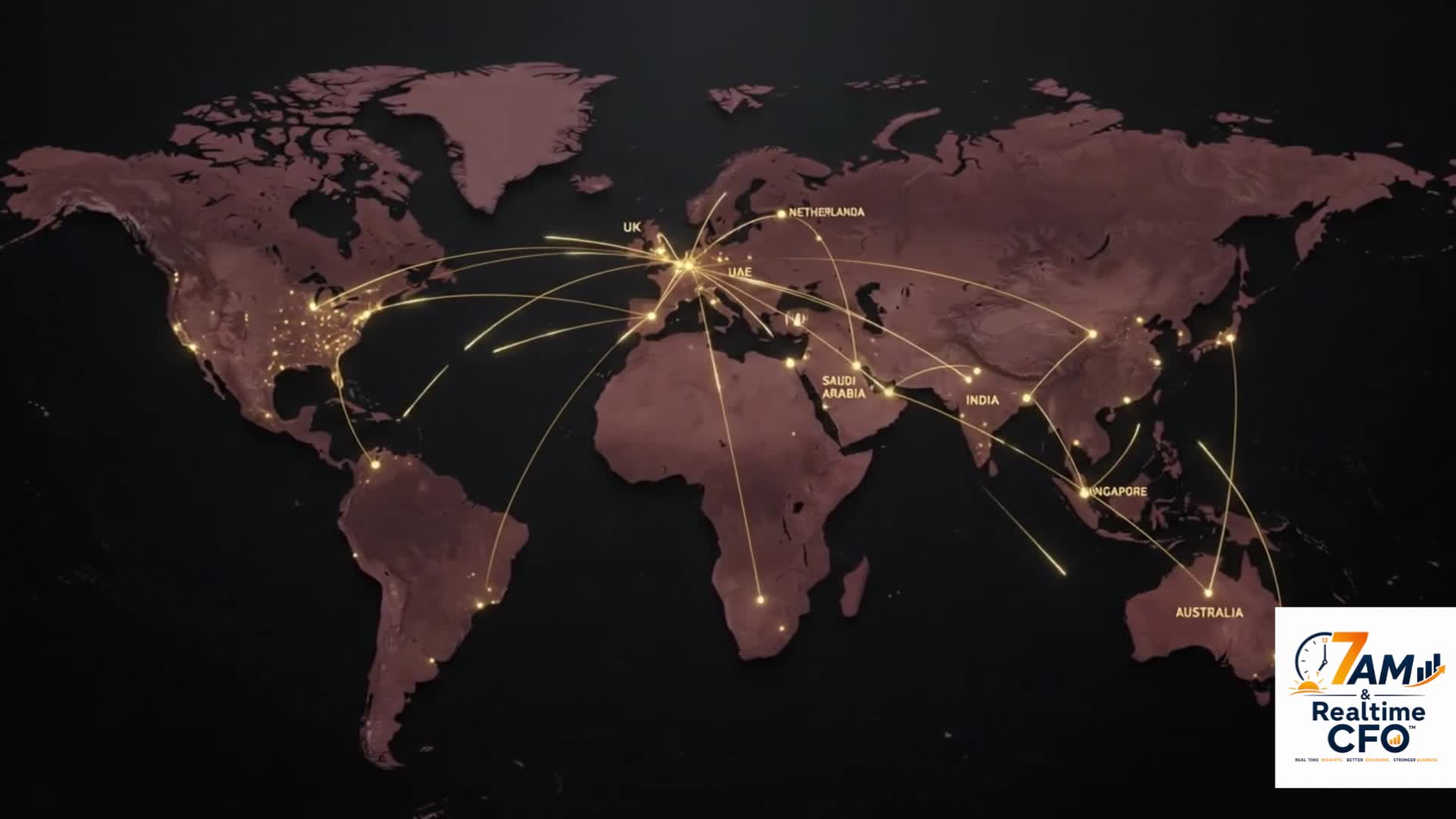
Seven -- India, UAE (top priority), UK, Singapore, Australia, Saudi Arabia and the Netherlands -- working remotely with founders and CFOs on their preferred channel.
Finance OS is the backend product -- a one-time setup that connects and cleans your data sources and finds what is actually leaking: fraud hiding in the last layer, margin bleeding by product or channel, and cash trapped in the working capital cycle.
One-time setup. It is the foundation -- once your data architecture is built and leakage is found, 7AM & Realtime CFO runs on top of it as the ongoing daily layer.
Common patterns include job work leakage, scrap and rejection fraud, ghost stock, marketplace margin leakage, payroll leakage, operating expense leakage, returns fraud, procurement leakage and expense-timing manipulation -- the 'last layer' issues that a normal monthly close does not surface.
Wherever your business actually keeps its numbers -- ERP systems, Excel, WhatsApp, PDFs, cloud drives, email and APIs -- consolidated into one clean, verified data architecture.
Ideally yes -- Finance OS is the backend that makes the daily 7AM report accurate and trustworthy. For simpler setups we can sometimes start directly with 7AM & Realtime CFO and build the deeper architecture in parallel.
Our methodology for finding leakage that sits below the surface of a normal P&L -- the layer most audits and monthly closes never reach, where fraud, margin bleed and working capital drag actually hide.
A bookkeeper records transactions. Finance OS is architecture -- built with Excel, Power Query, Python and SQL to actively find where money is leaking across inventory, vendors, channels and processes, not just keep the books current.
For when you need the full picture, not just today's decision -- every number, every variance, every trend, delivered as a live Power BI dashboard with full CFO narrative on what happened, why, and what to do next.
Weekly, with on-demand access to the live dashboard any time in between -- a living view of the business rather than a static monthly PDF.
The One Page News is the fast, single-page daily decision layer. The Full Report is the deep-dive -- every variance explained, every trend charted -- for the weekly strategic review, not the daily glance.
Power BI, built and automated so the numbers refresh without anyone re-keying them every month.
Senior finance leadership without a full-time hire -- strategic decisions, investor conversations, board presentations, lender relationships, fundraising support and business OS reviews, delivered as a monthly retainer.
Different names, same core idea -- Fractional CFO, Virtual CFO, Part-Time CFO, Interim CFO and Outsourced Finance Consultant all describe senior finance leadership engaged without a full-time hire; the differences are mostly in engagement style and duration.
A CFO engaged for a defined, often short-term period -- typically to cover a transition, a crisis, or a specific project -- rather than an ongoing retainer.
Businesses that have outgrown 'just an accountant' but are not yet ready for -- or do not need -- a full-time CFO on payroll: they need senior strategic thinking periodically, not daily bookkeeping.
No -- it is a strategic, decision-support layer. Day-to-day bookkeeping is handled separately (directly by your team or through our facilitated bookkeeping automation service).
It sits in our product hierarchy as Product 4, usually most valuable alongside Finance OS and 7AM & Realtime CFO, though it can be scoped independently depending on the business's stage.
The complete architecture -- Finance OS finds the leakage, 7AM & Realtime CFO delivers daily clarity, the Full Report gives the weekly deep-dive, and Fractional CFO provides the senior partner in the room. One engagement, every layer.
Custom, based on business size, data complexity and engagement scope -- there is no one-size-fits-all number because a single-entity D2C brand and a multi-country manufacturing group need very different depth of work.
Yes -- most engagements start with Finance OS or 7AM & Realtime CFO and expand into the Full Package as trust builds and the value becomes clear.
Building the basic finance architecture before it becomes a fire -- putting in right-sized controls, cash discipline and an Excel or Power BI-led reporting structure for businesses that currently have just an accountant closing books and a founder guessing the rest.
Fixing what scale already broke -- finding where a slower, spreadsheet-heavy finance function is leaking value, and re-architecting it with Power BI and automation, without disrupting day-to-day operations.
By where the business actually is, not its age -- if there is no finance function yet, it is the Startup approach; if a finance function exists but has not kept up with growth, it is the Established approach.
Yes -- multi-entity, multi-currency and multi-country structures are treated as an Established-company problem even if individual entities are relatively young, because the complexity is architectural, not just operational.
Ready-to-use finance templates and automation tools -- some free, some paid -- covering GST Reconciliation, Excel MIS, Power BI dashboards, Google Sheets automation, n8n workflow packs and AI automation kits for finance.
Both -- starter versions of GST Reconciliation and Excel MIS templates are free; more advanced and automated versions (Power BI Dashboard Kit, Google Sheets Automation Kit, n8n Workflow Pack, AI Automation Kit) are paid.
Excel, Power BI, Google Sheets and n8n -- covering both spreadsheet-based and no-code automation workflows for finance teams.
Fill the Notify Me form on the Templates page with your details and which template interests you -- you will be contacted directly once it is available.
Templates are self-serve tools for teams that want to run their own MIS and reconciliation process; 7AM & Realtime CFO is a fully managed daily service. Many businesses use templates for internal MIS while still relying on 7AM for daily decision-grade clarity.
A 20-question, five-minute self-assessment across Cash & Working Capital, Inventory, Costing and Controls -- it gives an instant Finance Clarity Score and your Top 3 Pain Points, based on your own answers.
A personalized, deeper report -- you share your basic business numbers and current pain points, and within 3 business days you get back your actual Top 5 Financial Gaps, each with the Problem, the Pain it is causing, the Solution, and the Expected Result.
The quiz is instant and self-scored based on generic questions. The 5-Gap Report is personalized -- prepared by us, based on your real numbers, and comes with a fix and expected result for each gap, not just a score.
Yes -- nothing shared is ever shown publicly, sold, or displayed as a case study without explicit permission. Our Golden Rule is authority through integrity, not secrecy: no ledger screenshots, no raw client reports, no identifiable data, ever.
Within 3 business days of submitting your details, delivered on email or WhatsApp based on your preference.
The Cash vs Profit Leak Finder, which shows where profit is stuck (vendors, receivables, inventory or fixed assets) with a Business Health Score, and the Finance Clarity Diagnostic, a 10-question, 3-minute version of the risk assessment.
Seven books so far, covering practical Excel, finance and MIS topics -- available through the Books section of the site, unlocked via a short enriched form (name, email, phone, country).
It lets us know who is engaging with the material so we can follow up with relevant resources -- the form is lightweight (no OTP or login required) specifically to keep friction low for a free resource.
Yes -- they unlock after the short enriched form is submitted, no payment required.
Bookkeeping automation, statutory bookkeeping/tax/audit support, company registration, secretarial/ROC compliance, standalone MIS services, and broader business process automation -- coordinated through our trusted CA and CS partner network.
These are facilitated through our trusted CA and CS partner network rather than done in-house, so you get one point of coordination instead of managing five separate vendors.
Yes, new entity setup and ROC/secretarial compliance are facilitated through our CS network as part of the broader service offering.
MIS setup and reporting delivered on its own, for businesses that want structured management reporting outside the full 7AM & Realtime CFO system.
Suraj Kumar Lohani -- a Finance Engineer and Finance OS Architect with 22+ years of experience in FP&A, MIS and Excel automation, author of 'Excel for Finance and Accounting', and founder of the Finance and Excel consultancy, based in Ghaziabad, Delhi NCR, India.
The easiest first step is the Free Diagnostic (5 minutes, instant score) or the free 5-Gap Financial Diagnostic Report (personalized, 3 business days) -- both are free entry points before any paid engagement.
Use the Get in Touch form on the Contact page, or message directly on WhatsApp -- we reply within one business day.
WhatsApp -- DM "DEMO" to +91-7011283542 for the fastest reply, or use the floating WhatsApp button available on every page of the site.
Yes -- we currently serve founders and CFOs across India, UAE (top priority), UK, Singapore, Australia, Saudi Arabia and the Netherlands, all remotely on the client's preferred channel.
The free Diagnostic and 5-Gap Report are the standard ways to experience the underlying approach before any retainer discussion; specific short-term trial arrangements can be discussed during the consultation.
The report is delivered directly on messaging channels you already use (WhatsApp, Email, Slack, Telegram, Teams) rather than requiring a separate app to download and check.
The core structure (Cash Position, Cash vs Profit, Variance Flags, Inventory, Working Capital, Today's Decisions, Data Confidence) is standard, though emphasis and depth can be tailored to what matters most for your specific business.
As a monthly retainer arrangement, terms for pausing or cancelling are agreed at the start of the engagement -- reach out directly to discuss your specific situation.
Current offerings (7AM & Realtime CFO, Finance OS, Fractional CFO) are engagement-based per business, while the books and free tools serve as broader, self-serve resources for anyone.
The Full Package bundles Finance OS, 7AM & Realtime CFO, the Full Report and Fractional CFO into one coordinated engagement, typically priced to reflect the efficiency of one integrated setup rather than four separate, disconnected engagements.
Where relevant, especially in CFO Services for Startups engagements, building internal team capability is often part of establishing the right-sized finance architecture, not just delivering a black-box report.
Data handling and continuity terms at the end of an engagement are agreed upfront as part of the engagement contract -- specifics can be discussed directly during onboarding.
Product features (like the two-mode 7AM/CURRENT delivery, or the addition of the 5-Gap Report) have evolved directly from what clients and prospects actually asked for during real conversations.
Referral arrangements can be discussed directly -- reach out via Contact or WhatsApp if you would like to refer another business.
The free tools and diagnostics are built with the same rigor as the paid products -- they are intentionally scoped smaller (self-serve, instant, generic), not lower quality, so they serve as a genuine, honest preview of the approach.
Standalone MIS Services (part of our facilitated offerings) covers exactly this -- dashboard and reporting setup without the full daily managed service.
The Company Profile PDF and various case study materials reference the format using our demo companies (Suraj Kumar Lohani Foods Pvt. Ltd. and SKL Al Noor Trading LLC) -- ask via Contact or WhatsApp for a walkthrough.
Yes -- reporting and analysis are structured around whatever financial year the business actually uses (which varies by country, as covered in our Country Compliance section), not forced into a calendar-year assumption.
Facilitated bookkeeping, tax, audit and company registration services sit alongside the Full Package rather than being automatically bundled into it -- they can be coordinated together during scoping if needed.
Partner engagements are governed by the same confidentiality expectations as our own team's work -- data is shared with partners only as needed for the specific filing or compliance task at hand.
The daily report and underlying architecture are structured per business unit or entity, so each segment gets analysis appropriate to its own industry dynamics rather than being blended into one generic view.
Yes -- both are freely accessible with no login, usable by anyone wanting to apply the underlying logic to their own numbers, independent of any future engagement.
Scoped, one-off diagnostic or project work (like a specific leakage investigation, or a one-time MIS build) can be discussed directly -- not every engagement needs to be an ongoing retainer from day one.
Documentation of the new architecture, reconciliation processes and any SOPs built during the engagement is typically part of the deliverable, so the client team understands and can maintain the system going forward.
The free Diagnostic and 5-Gap Report function as the standard no-cost proof-of-concept; a scoped short pilot for paid work can be discussed directly based on the specific business situation.
The product hierarchy is a starting framework, not a rigid constraint -- custom-scoped engagements combining elements from different products are common once your specific situation is understood during consultation.
CFO Services for Startups is scoped for exactly this stage -- building the basic finance architecture before revenue complexity arrives, rather than requiring an already-operating business.
The CFO Playbook (Book 3) is a good single starting point for someone who already has basic finance literacy and wants practical, CFO-level decision frameworks quickly.
From early-stage startups up to roughly ₹1,000 Crore / USD 100M+ -- if your business runs anywhere in that range, there's a place for you in the system.
No -- early-stage startups are explicitly within the served revenue range, particularly those wanting to build finance discipline before it becomes a crisis.
Reach out directly via Book a Demo or Free Consultation -- the stated range reflects where the system serves best, but specific fit is best discussed directly.
Larger enterprises are welcome to reach out -- the range reflects typical current engagements, not a hard cutoff.
Business complexity (entities, data sources, countries) affects pricing more directly than revenue alone -- a smaller business with complex multi-entity operations may cost more to set up than a larger, simpler single-entity one.
Because the same system architecture -- Finance OS, 7AM & Realtime CFO -- genuinely scales from early-stage to large enterprise, just with different depth of setup.
The range is shown in both ₹ and USD to reflect the mixed India/international client base across the 7 countries served.
CFO Services for Startups is framed specifically around building the basic finance architecture from day one, rather than fixing what scale has already broken.
Typically businesses toward the more complex end -- multiple entities, higher revenue, or known leakage/control issues -- since the Full Package bundles all four product layers.
The free Diagnostic quiz or a Free Consultation are the fastest ways to get a direct read on fit, rather than guessing from the revenue range alone.
Much of the business's growth approach is built on trust and word-of-mouth among founders -- Fin-vite reflects that "most conversations here start" through a genuine recommendation.
Both paths lead to the same free entry points -- Diagnostic quiz, Book a Demo, Free Consultation -- there's no different tier of service based on how someone arrived.
Yes -- the system is designed for founders across all 7 countries served (India, UAE, UK, Singapore, Australia, Saudi Arabia, Netherlands), not just India.
That would depend on whether the referred founder chooses to mention it or engage directly with you -- there's no automatic notification described for this feature.
Thin margins that hide inventory ageing, high SKU counts that make product-level profitability hard to see, scheme and discount costs that blur base pricing, and cash trapped in distributor and retailer receivables.
By surfacing SKU-level contribution margin, inventory ageing by fast/slow/dead stock, and receivable ageing from distributors -- the exact areas where FMCG margin quietly leaks between the P&L and the bank account.
SKU-level contribution margin, inventory turnover and ageing, distributor receivable days, scheme/discount cost as a percentage of sales, and freight cost per unit.
It often gets buried inside the base product cost instead of being isolated, which makes true margin invisible until it shows up as a cash shortfall months later.
FMCG products often have shelf life and seasonal demand -- slow-moving or near-expiry stock ties up working capital and eventually forces write-downs if not caught early.
Yes -- the daily report can be structured to show cash, inventory and margin at the SKU, brand or product-line level depending on how granular the business needs it.
Extended credit terms to distributors combined with slow collections create a working capital gap that FMCG founders often only notice once cash gets tight, not when it starts building up.
Minimum Order Quantity terms from vendors often push FMCG businesses into buying more raw material or packaging than they need, quietly locking up cash in excess stock.
It helps by giving clean, current cost and margin data so launch decisions are based on real contribution margin, not assumptions carried over from an existing SKU.
Returns and rejections are frequently measured only in units, not financial impact -- without tracking their cost, true product profitability stays hidden.
GST on multiple SKU categories (rate classification matters), e-invoicing above the applicable turnover threshold, and FSSAI-related cost and labelling considerations that indirectly affect costing.
Yes -- cash, receivables and margin can be tracked and compared across channels, since each channel typically behaves very differently on payment terms and true profitability.
Marketplace commissions and fees that quietly erode margin, return rates that are higher than traditional retail, cash collection delays from marketplaces, and inventory spread across multiple fulfilment centers or warehouses.
By tracking true landed margin after marketplace fees, ad spend and returns -- the numbers that determine whether a 'best-seller' SKU is actually profitable once every cost is accounted for.
The gap between the margin a D2C brand thinks it is making and what it actually keeps, after marketplace commissions, payment gateway fees, return processing costs and ad spend are netted out.
Contribution margin after marketplace fees, customer acquisition cost versus lifetime value, return rate by SKU, inventory turnover, and cash conversion cycle across marketplace payout cycles.
Marketplaces typically hold and release payments on a cycle (often 7-15 days after delivery), so revenue on paper does not match cash in the bank -- this is a classic Cash vs Profit gap our daily report is built to explain.
Yes -- the report can be structured to show cash, returns and margin channel-by-channel, since Amazon, Flipkart, Myntra and a brand's own D2C website all behave very differently financially.
Each return usually carries reverse logistics cost, restocking effort and sometimes damaged/unsellable inventory -- if return cost is not tracked at SKU level, true product profitability is overstated.
Physical retail carries shelf-space and dead-stock risk concentrated by store location, while e-commerce inventory risk is spread across fulfilment centers and complicated by returns -- both need different ageing and reorder logic.
Data can be pulled from wherever it lives, including marketplace reports, Shopify/website backend exports and Excel -- the goal is consolidating it into one clean daily view, regardless of source.
It varies by category, but the goal is to keep cash tied up in inventory and receivables as short as possible relative to marketplace payout timelines -- we benchmark this against your specific channel mix rather than a generic industry number.
E-commerce operators and sellers have specific GST TCS (tax collected at source) provisions and e-invoicing requirements above applicable turnover thresholds -- these are handled through our facilitated CA network alongside the core finance work.
Fixed asset and machine utilisation that is rarely tracked financially, raw material Purchase Price Variance (PPV), scrap and rejection costs, energy cost per unit, and working capital locked in work-in-progress inventory.
By surfacing machine utilisation percentage, PPV trends, scrap cost impact and SKU/product-level contribution margin -- the layer where manufacturing margin usually bleeds without being visible in a standard P&L.
Fixed asset/machine utilisation %, Purchase Price Variance, scrap and rejection cost, energy cost per unit produced, and raw material inventory turnover.
The difference between the planned/standard cost of raw material or packaging and what was actually paid -- tracking it regularly catches procurement cost creep before it erodes margin silently.
Most factories measure scrap in units or weight but not in financial terms -- without costing the rejection, the true margin impact of a quality issue stays invisible to finance.
A machine running at 60% capacity is quietly absorbing depreciation and fixed cost without proportional output -- tracking utilisation financially (not just operationally) shows the real cost per unit produced.
WIP is tracked as part of the inventory and working capital sections of the daily report, since capital tied up mid-production is just as real a cash constraint as finished goods sitting in a warehouse.
Yes -- energy cost benchmarking per unit is one of the standard costing metrics we build into manufacturing engagements, since energy is often a top-3 variable cost that is rarely isolated per unit.
Freight and scheme/discount costs are separated from base product cost so true ex-factory margin is visible, rather than blended into one number that hides where cost is actually coming from.
Yes -- data is pulled from whatever ERP, Excel or manual system the factory already uses; the goal is consolidating and verifying it, not forcing a system change.
GST on raw material and finished goods (often at different rates), e-invoicing above threshold, and statutory cost record-keeping in regulated sectors -- handled through the facilitated CA network alongside daily finance work.
It focuses on job-work leakage (material sent for outside processing not reconciled back), scrap fraud, and procurement leakage -- classic manufacturing-specific leakage patterns a normal monthly close rarely catches.
Thin margins that make even small cost or pricing errors material, inventory spread across multiple locations or principals, receivable risk from a large dealer/retailer network, and currency exposure on imported goods.
By giving daily visibility into receivable ageing across a dealer network, inventory ageing by product line, and margin after landed cost -- the areas where distribution businesses most commonly lose money without noticing.
Receivable days by dealer/customer, inventory turnover by product line, landed cost margin, and currency/FX exposure on imports.
Landed cost includes freight, customs duty, insurance and handling on top of the purchase price -- if margin is calculated only on purchase price, true profitability per product line is overstated.
Through receivable ageing tracked at the individual dealer/customer level in the daily report, so slow payers are flagged early rather than discovered at month-end reconciliation.
Yes -- FX exposure on outstanding import payables and its impact on landed cost is tracked as part of the working capital and cash view where relevant.
Data from each location is pulled into one consolidated daily view, so total inventory position and ageing is visible at the company level, not just branch by branch.
Ghost stock -- inventory recorded on the books that does not physically exist, often surfacing only during a rare physical count; the Last Layer Approach is built to catch this pattern earlier.
By showing payable ageing and cash commitment to each supplier alongside incoming receivables, so cash planning around supplier terms is proactive rather than reactive.
Input tax credit reconciliation across multiple purchase and sale transactions is a common pain point, since ITC mismatches directly affect cash flow -- this is handled through our facilitated CA network alongside daily finance work.
Revenue recognition timing versus cash collection, unbilled work-in-progress that is hard to value, utilisation and billability of people-based delivery, and receivable risk concentrated in a small number of large clients.
By tracking cash versus recognized revenue, unbilled WIP, and client-level receivable ageing -- the metrics that matter most when the core asset is people's time rather than physical inventory.
Utilisation rate (billable vs total hours), realization rate (billed vs standard rate), receivable days by client, and unbilled revenue ageing.
There is usually no physical inventory, but unbilled work-in-progress and receivables from concentrated clients function the same way inventory does for a product business -- capital sitting uncollected.
Time worked but not billed, scope creep not captured in invoicing, or discounts given informally without being tracked -- all of which quietly reduce realized revenue below what was actually delivered.
Yes -- profitability can be structured at the project, client or service-line level depending on how the business needs to see it.
By flagging when receivables or revenue are concentrated in a small number of clients, since a single client payment delay can create a disproportionate cash impact.
GST on services (place of supply rules can be complex for cross-state or cross-border delivery), TDS on professional/technical services, and export of services provisions if serving international clients.
Long project cycles that make cash flow forecasting difficult, construction-linked payment plans from customers that do not match construction cost timing, land and work-in-progress valuation, and RERA-related compliance and escrow requirements in India.
By tracking project-wise cash flow against construction milestones, customer collection versus payment plan schedules, and working capital tied up in land and WIP -- the specific timing mismatches that make real estate cash management hard.
Collection efficiency against payment plan milestones, project-wise cash burn versus construction progress, RERA escrow compliance status, and inventory (unsold units) ageing.
In India, a defined percentage of customer collections must be deposited into a project-specific escrow account and used only for that project's construction cost -- tracking this correctly is both a legal and cash-planning requirement.
By allocating land cost, construction cost, approval/compliance cost and overheads to each project separately, so profitability is visible project-by-project rather than blended at the company level.
The daily report can be structured to show cash, collections and construction cost separately for each ongoing project, alongside a consolidated company-level view.
Completed or near-completed units not yet sold -- tracked similarly to product inventory ageing, since capital locked in unsold units directly affects cash position and financing cost.
RERA registration and disclosure requirements, escrow account rules, GST on under-construction property, and stamp duty/registration considerations -- handled alongside core finance work through our facilitated network where needed.
Franchise Owned, Company Operated -- the franchise partner owns the outlet/asset while the parent company operates it. Finance challenges include reconciling revenue share/rent payable to the franchise owner, and separating outlet-level operating cost from company overhead.
By tracking outlet-level P&L separately from company overhead, and by keeping franchise owner payouts (rent/revenue share) reconciled and current, so disputes over what is owed do not build up unnoticed.
Outlet-level contribution margin after franchise payout, same-outlet sales growth, inventory and cash handling accuracy at each outlet, and franchise payout reconciliation accuracy.
Through daily/weekly reconciliation of outlet-level cash collections against sales records, since multi-outlet cash handling is one of the most common leakage points in FOCO and COCO models.
In FOCO, franchise owner payout reconciliation is a distinct, ongoing finance obligation; in COCO the company owns both the asset and operations, so that specific payout layer does not exist, but full outlet P&L ownership does.
Company Owned, Company Operated -- the parent company owns both the asset and runs operations. The main challenges are outlet-level P&L visibility across potentially many locations, and cash/inventory control at each site.
By consolidating outlet-level cash, inventory and margin into one daily view, while still allowing drill-down to any single outlet -- so underperforming locations are visible quickly, not buried in a company-wide average.
Outlet-level contribution margin, same-store sales growth, inventory shrinkage by outlet, and labour cost as a percentage of outlet revenue.
By comparing expected inventory (based on sales and purchases) against actual stock at each outlet, flagging outlets with shrinkage patterns that suggest pilferage or process gaps.
Yes -- since all outlets are company-owned and operated, the daily report can rank or compare outlets directly on cash, margin and inventory metrics on a like-for-like basis.
Royalty and franchise fee collection and reconciliation across many franchisees, inconsistent financial reporting quality from franchisee-run outlets, and visibility into brand-wide performance when each outlet may use a different system.
By consolidating franchisee-reported numbers into one standardized daily or weekly view, and tracking royalty/fee collection status across the network, regardless of what system each franchisee uses locally.
Royalty collection rate and ageing, brand-wide same-store sales trends, franchisee-level profitability where reported, and compliance/reporting consistency across the network.
By setting a standard minimum reporting template and using a Data Confidence score in the daily report, so the business always knows which franchisees' numbers are fully verified versus still pending.
Yes -- franchisors get network-wide visibility, while individual franchisees can also use 7AM & Realtime CFO for their own outlet-level daily clarity independent of the franchisor's systems.
Seasonal working capital build-up is tracked explicitly in the Cash and Inventory sections, so the temporary spike in stock and receivables around a festive season is understood as expected, not mistaken for a permanent deterioration.
Food products typically carry shorter shelf life and tighter ageing tolerances, while personal care products often carry longer shelf life but higher marketing/scheme spend as a percentage of revenue -- both need SKU-level margin tracking, just tuned to different risk factors.
Private label typically runs on thinner margins with less scheme/marketing cost, making working capital and PPV discipline even more critical, since there is less margin cushion to absorb inefficiency.
Omnichannel adds store-level cash handling, rent and inventory-per-location complexity on top of the marketplace/D2C dynamics -- both channel types need separate tracking, since profitability drivers differ significantly.
Quick-commerce models carry inventory across many small, distributed dark stores -- ageing and shrinkage risk is harder to see without location-level tracking, since averages across many small stores can hide a few consistently poor performers.
As a direct component of customer acquisition cost that must be measured against actual customer lifetime value, not just tracked as a blanket 'marketing expense' -- otherwise, spend can look justified on volume while actually destroying margin per customer.
Textile manufacturing often carries higher raw material price volatility (cotton, yarn) and seasonal export order patterns, making PPV tracking and working capital planning around order cycles especially important.
Higher regulatory compliance cost, batch-level costing and traceability requirements, and typically longer receivable cycles with institutional buyers -- all needing more granular costing than simpler manufacturing categories.
Heavy dependence on a small number of large OEM customers (concentration risk), tight just-in-time delivery penalties, and thin margins that make PPV and scrap tracking especially critical.
Shelf-life-driven inventory ageing similar to FMCG, plus raw material (agricultural commodity) price volatility that needs to be tracked and hedged where possible.
Import-heavy trading carries FX exposure on payables and customs/duty cost complexity; export-heavy trading carries FX exposure on receivables and often longer collection cycles tied to international buyer terms and documentation (like Letters of Credit).
Heavy dependence on one supplier/principal concentrates both margin and continuity risk -- if the principal changes terms, pricing or exits the relationship, the distributor's entire business model can be disrupted at once.
IT services often have more complex project-based revenue recognition (milestones, fixed-price vs time-and-material) while professional services more commonly bill by time/retainer -- both need accurate unbilled WIP tracking, but the recognition rules differ.
Monthly/annual recurring revenue, churn rate, and client-level margin after delivery cost -- similar in spirit to SaaS metrics, applied to a people-delivered service.
Commercial projects typically have longer lease-based revenue cycles and depend heavily on occupancy rates, while residential projects depend on unit sales velocity and payment-plan collection against construction milestones.
Customer collections often front-load early in a project (booking amount, early installments) while major construction cost is incurred later -- or vice versa depending on the payment plan structure -- so cash flow timing needs project-specific modelling, not a generic assumption.
A franchise partner funds and owns the outlet setup while the parent brand operates it day-to-day, which is common in QSR expansion -- reconciling the franchise owner's rent/revenue share against actual outlet performance is the key recurring finance task.
COCO gives full control over brand experience and financial performance at high-visibility locations, at the cost of carrying full capital investment and operational risk directly -- it is often used selectively alongside FOCO/franchise models for scale.
Reviewing the franchisor's disclosed unit economics, actual same-store sales trends across the existing network, and the true all-in cost of royalty plus marketing fees plus mandatory supply arrangements -- not just the headline franchise fee.
Model incremental working capital needs (new distributor credit, region-specific inventory build-up) separately from existing operations, since new-market entry often strains cash well before it becomes profitable.
Model the inventory build-up cost ahead of the event against the delayed marketplace payout after it, since the cash outlay for stock typically happens weeks before the corresponding cash inflow arrives.
A rising trend in machine downtime cost combined with falling utilisation percentage -- tracked together, they often signal maintenance issues before a full breakdown forces unplanned capital expenditure.
Model the cash outlay for the bulk purchase against realistic sell-through time and receivable collection -- a discount that looks attractive on unit economics can still create a serious cash strain if sell-through is slower than assumed.
Weigh the relationship value against the true cost of the extended DSO (using working capital cost as a benchmark), and consider renegotiating terms or requiring partial upfront payment rather than absorbing the cash strain indefinitely.
Often through a mix of promoter equity, structured debt against the land, and sometimes early-stage investor capital -- since customer collections (the main later-stage funding source) only begin after launch and initial sales.
Each marketplace has different fee structures, payout cycles and return policies -- spreading too thin without financial visibility per channel can hide which channels are actually profitable versus which are just adding volume without margin.
Model landed cost including international shipping, customs and return logistics (often much higher for cross-border returns) against the incremental margin -- international orders that look attractive on revenue alone can be marginal or loss-making once true cost is included.
A composite metric combining availability, performance and quality of a production line -- while primarily an operations metric, low OEE directly translates to higher cost per unit produced, making it financially relevant even though it starts as a shop-floor number.
Under consignment, inventory remains the principal's property until sold, so it typically should not appear on the distributor's own balance sheet as owned stock -- getting this accounting treatment wrong overstates the distributor's true asset and risk position.
Fixed-fee pricing requires accurate effort estimation upfront and carries scope-creep risk for the provider; time-and-material shifts that risk to the client but requires disciplined time tracking -- the right choice depends on how well-defined the project scope actually is.
Delays extend the period before customer collections convert into completed, sellable inventory, increasing financing cost and potentially triggering RERA-related penalty or refund obligations to customers. (This is general awareness information under current rules, not tax or legal advice -- please verify specifics with your CA or local advisor before filing.)
Through a transparent, jointly-agreed reporting format and reconciliation cadence (ideally daily or weekly, not just monthly), so both the operating company and the franchise owner see the same numbers at the same time.
A consistent negative contribution margin trend over several months (not just a single bad month) at that specific outlet, after accounting for outlet-level fixed costs -- a single-month dip is usually noise, a sustained trend is a real signal.
Most commonly a percentage of gross revenue, sometimes combined with a smaller flat monthly fee -- the exact structure depends on the brand's positioning and the typical unit economics of its franchisees.
By tracking the full cost -- discount given, additional volume sold, and any cannibalization of full-price sales -- rather than just the headline discount percentage, since schemes can look successful on volume while actually destroying margin.
COD typically carries higher return/refusal rates and delayed cash realization compared to prepaid orders, so true margin and cash flow modelling should treat COD and prepaid orders as financially distinct cohorts, not blend them together.
By comparing the fully-loaded in-house cost (including fixed asset utilisation and overhead absorption) against job work pricing plus the added reconciliation risk (job work leakage), rather than comparing job work price against only the variable cost of insourcing.
Seasonal or fashion-linked goods lose value quickly once a season passes, making timely markdown and clearance decisions financially urgent -- delaying a markdown decision to avoid recognizing a loss usually makes the eventual loss larger.
By tracking non-billable time and its fully-loaded cost against total headcount cost, since high bench cost directly compresses overall realization rate and profitability even when individual project margins look healthy.
Blended cash flow across all active projects against total committed construction cost and collection schedules -- project-by-project health can look fine individually while portfolio-level cash timing creates an aggregate crunch.
With the shift to mainly two slabs, some products may have moved rate bands -- businesses need to re-verify HSN code classification across their full SKU list to avoid under- or over-charging GST. (This is general awareness information under current rules, not tax or legal advice -- please verify specifics with your CA or local advisor before filing.)
Concentration risk -- a policy change, account suspension, or fee increase from that one marketplace can disproportionately impact the entire business, making channel diversification a genuine financial risk-management decision, not just a growth strategy.
Compare the capital cost and payback period of automation against the current labor cost, scrap/quality improvement, and capacity gain -- automation ROI often looks weaker on labor savings alone but stronger once quality and capacity gains are included.
Clear payment terms agreed in writing, an initial smaller order to validate quality and reliability before scaling volume, and monitoring landed cost consistency across the first several orders before assuming pricing is stable.
Actual hours delivered consistently exceeding the hours originally quoted or contracted, without a corresponding change order or additional billing -- a sign that realization rate is being silently eroded.
A JDA (common where a landowner partners with a developer, sharing either area or revenue instead of an outright land sale) changes how land cost, revenue share and project cash flow are recognized and split between the two parties -- requiring specific accounting treatment.
Through a combination of forward purchase contracts, safety stock buffers sized to price-risk tolerance, and pass-through pricing clauses with customers where market position allows it.
Reduces per-unit freight and customs handling cost, though it requires more working capital tied up per shipment -- a trade-off that should be modelled explicitly rather than assumed to always favor consolidation.
Quick-commerce channels often carry different (usually thinner) margins and faster but smaller-batch inventory cycles compared to general trade -- blending the two channels into one margin number hides which channel is actually driving profitability.
Verify RERA registration status, existing customer collection and construction progress alignment, encumbrances on the land, and any pending litigation -- real estate due diligence carries more legal-financial overlap than most other industries. (This is general awareness information under current rules, not tax or legal advice -- please verify specifics with your CA or local advisor before filing.)
It ties up working capital unnecessarily and increases obsolescence risk for materials with any shelf life or technology change risk -- safety stock should be calculated from actual demand and lead-time variability, not set on instinct.
Move from founder-managed spreadsheets toward SKU-level margin tracking, marketplace-level reconciliation, and daily cash visibility -- typically the point where informal tracking starts hiding real problems rather than just being inefficient.
Undocumented, informally extended credit terms tend to drift longer over time and are harder to enforce or dispute if a payment issue arises -- formalizing terms in writing protects both the relationship and the cash position.
Compare the fully-loaded cost of a dedicated hire against the current cost and quality gap of outsourced/fractional support, factoring in how quickly the business's complexity (client count, entities, reporting needs) is actually growing.
Outlet-level sales, cost and payout reconciliation on an agreed regular cadence -- ideally matching or exceeding the frequency the operating company itself uses internally, to avoid information asymmetry.
Comparing the cost of predictive maintenance systems against the avoided cost of unplanned downtime and emergency repairs -- for capital-intensive manufacturing, unplanned downtime cost is often far higher than the maintenance investment itself.
FX exposure, LC (Letter of Credit) and credit-term slippage, and in-transit inventory risk are among the most common blind spots this system is built to surface.
By flagging currency exposure and variance as part of daily Cash Position and Variance Flag reporting, so FX risk isn't discovered only at month-end.
Letters of Credit and supplier/buyer credit terms slipping past agreed timelines can quietly strain working capital -- this is tracked as part of the Working Capital section of the daily report.
In-transit stock is tracked as part of inventory visibility, so goods on the water or in customs aren't a blind spot between "shipped" and "received."
Yes -- multi-currency handling is part of Master Data Setup during implementation, relevant for businesses trading across the 7 countries served.
Cash tied up in transit inventory and extended buyer credit, while supplier payment terms remain fixed -- creating a working capital squeeze the daily report is designed to flag early.
Core integration focuses on financial and accounting systems; shipping/customs documentation can be incorporated as a data source where relevant, scoped during Discovery & Analysis.
Yes -- the Trading CFO page covers this industry's specific pain points and how the system addresses them.
Businesses buying and selling across borders -- commodity traders, import-export merchants, and distribution businesses with significant cross-border exposure.
The Last Layer Approach™ and Rakshak's 12-layer checks apply the same way as any inventory-driven business -- reconciling what's recorded against physical/documentary reality, relevant to shipments, LCs and customs paperwork.
Utilization blind spots, project profitability lag, and milestone receivables are the most common visibility gaps for services and consulting firms.
Not knowing in near-real-time how billable your team's time actually is against capacity -- a key driver of margin that's easy to lose visibility on without daily tracking.
The delay between a project actually becoming unprofitable and someone noticing -- often discovered only at project close instead of while there's still time to act.
Milestone receivables are tracked as part of Working Capital and Cash vs Profit reporting, so revenue recognized on paper versus cash actually collected stays visible.
Yes -- while much of the system's origin is inventory-driven businesses, the same Cash Position, Cash vs Profit, and Working Capital logic applies directly to project-based services businesses.
Project or client-level profitability tracking can be built into the reporting layer during implementation, similar to how SKU or channel-level tracking works for product businesses.
By connecting utilization and billing data into the daily visibility layer, so a dip in billable utilization shows up as a flag, not a surprise at month-end.
Yes -- the Services CFO page covers this industry's specific pain points and how the system is applied to them.
Consulting firms, agencies, professional services and similar project- or retainer-based businesses where time, utilization and milestone billing drive cash flow.
Because services businesses have real, if less obvious, finance leakage -- unbilled time, delayed milestone invoicing, project margin erosion -- that daily visibility catches just as effectively as it does for inventory-driven businesses.
Batch and expiry risk, distributor credit stretch, and TPA (insurance) reimbursement delays are the core pain points this system addresses for this sector.
TPA and insurance reimbursement claims can sit unresolved for months, tying up cash the hospital has already effectively earned but not yet collected.
A dedicated TPA & Insurance Reconciliation step tracks claims against expected reimbursement timelines, surfacing aged or stuck claims before they become a serious cash gap.
The financial exposure from inventory nearing expiry or requiring batch-level tracking for compliance -- unmanaged, this becomes write-offs that quietly erode margin.
When distributors take longer than agreed credit terms to pay, straining the manufacturer or wholesaler's own working capital -- tracked as part of receivables/DSO visibility.
Yes -- the page was expanded to explicitly cover Pharma, Healthcare & Hospital together, since TPA reimbursement delay is a shared pain point across these related sectors.
The same Last Layer Approach™ applies -- reconciling batch-level physical stock, distributor claims and TPA reimbursement records against what the system shows, rather than trusting system records alone.
Yes -- claims tracking can be structured to cover multiple TPAs and insurance providers as data sources during implementation.
Yes -- hospitals specifically face the TPA reimbursement delay pain point, which is why Hospital was explicitly added alongside Pharma and Healthcare on this industry page.
The combination of expiry-driven inventory write-off risk and long, often opaque TPA/insurance reimbursement cycles -- a compounding cash trap less common in non-healthcare sectors.
Under current rules, the base rate for domestic companies is 25%, with a concessional 22% option under Section 115BAA (no exemptions, opt-in), and 15% for new manufacturing companies incorporated after October 2019 under Section 115BAB. (This is general awareness information under current rules, not tax or legal advice -- please verify specifics with your CA or local advisor before filing.)
Goods and Services Tax is India's indirect tax. Under the GST 2.0 reform effective September 2025, the structure is mainly two slabs -- 5% and 18% -- with a 40% rate on luxury and sin goods. (This is general awareness information under current rules, not tax or legal advice -- please verify specifics with your CA or local advisor before filing.)
Under current rules, Rs.40 lakh annual turnover for goods (Rs.20 lakh in special-category states), and Rs.20 lakh for services (Rs.10 lakh in special-category states). (This is general awareness information under current rules, not tax or legal advice -- please verify specifics with your CA or local advisor before filing.)
Fixed nationally at April 1 to March 31 -- companies do not have the option to choose a different financial year, unlike some other countries.
Yes -- under the Companies Act, statutory audit is mandatory for all companies regardless of size, unlike some countries that exempt small companies. (This is general awareness information under current rules, not tax or legal advice -- please verify specifics with your CA or local advisor before filing.)
Under current rules, it applies to businesses with turnover above Rs.1 crore (Rs.10 crore if at least 95% of transactions are digital), and to professionals with gross receipts above Rs.50 lakh. (This is general awareness information under current rules, not tax or legal advice -- please verify specifics with your CA or local advisor before filing.)
Ind AS (IFRS-converged) applies to larger and listed companies above specified thresholds; smaller companies below those thresholds follow the older 'AS' standards.
Monthly by default (GSTR-1 and GSTR-3B); the QRMP scheme allows quarterly return filing with monthly tax payment for businesses with turnover up to Rs.5 crore. (This is general awareness information under current rules, not tax or legal advice -- please verify specifics with your CA or local advisor before filing.)
Yes, above a specified turnover threshold under current GST rules -- the threshold has been progressively lowered over recent years, so it is worth confirming current applicability for your turnover band. (This is general awareness information under current rules, not tax or legal advice -- please verify specifics with your CA or local advisor before filing.)
GST was simplified from a 4-slab structure (5/12/18/28%) to mainly two slabs (5% and 18%) plus a special 40% rate for luxury/sin goods, effective September 22, 2025 -- referred to as 'GST 2.0'. (This is general awareness information under current rules, not tax or legal advice -- please verify specifics with your CA or local advisor before filing.)
Tax Deducted at Source -- businesses must deduct tax at prescribed rates on specified payments (salaries, professional fees, rent, contractor payments, etc.) and deposit it with the government, which directly affects cash flow timing and compliance workload.
ITC lets a business offset GST paid on purchases against GST collected on sales; mismatches or delays in ITC reconciliation directly increase the effective cash tax outflow, making it a common working capital pain point.
Only those crossing the applicable turnover threshold (or engaged in specified categories requiring compulsory registration regardless of turnover, such as inter-state supply or e-commerce operators). (This is general awareness information under current rules, not tax or legal advice -- please verify specifics with your CA or local advisor before filing.)
The Real Estate (Regulation and Development) Act applies to real estate developers, requiring project registration, escrow account maintenance for customer collections, and specific disclosure and reporting obligations.
Registering as a Micro, Small or Medium Enterprise under Udyam can unlock benefits like priority payment timelines from larger buyers, easier credit access, and certain compliance concessions.
The daily report can flag data confidence and reconciliation status around statutory items, though actual filing is handled through our facilitated CA network -- 7AM focuses on the finance visibility layer, not the filing itself.
Ind AS is India's IFRS-converged standard, mandatory for larger and listed companies above specified net worth/listing thresholds; smaller companies below those thresholds continue to follow the older Accounting Standards (AS).
Once applicable, every B2B invoice above the threshold must be registered on the government's Invoice Registration Portal to get a unique reference number -- this needs to be built into billing systems and processes, not handled as an afterthought.
GST rate misclassification across SKUs (especially post the 2025 rate simplification) and ITC mismatches from vendor non-compliance -- both directly affect cash flow if not monitored regularly. (This is general awareness information under current rules, not tax or legal advice -- please verify specifics with your CA or local advisor before filing.)
Yes -- state-wise GST registrations and reconciliation can be consolidated into one company-wide daily view, alongside state-level detail where needed.
Under current rules, 0% on taxable income up to AED 375,000 and 9% above that. Qualifying Free Zone entities can retain 0% on qualifying income if conditions are met; large multinational groups above a high consolidated revenue threshold face an additional 15% top-up tax. (This is general awareness information under current rules, not tax or legal advice -- please verify specifics with your CA or local advisor before filing.)
Value Added Tax, standard rate 5% under current rules -- one of the lowest VAT rates globally, introduced in 2018. (This is general awareness information under current rules, not tax or legal advice -- please verify specifics with your CA or local advisor before filing.)
Under current rules, mandatory registration applies above AED 375,000 taxable turnover in a 12-month period, with voluntary registration available from AED 187,500. (This is general awareness information under current rules, not tax or legal advice -- please verify specifics with your CA or local advisor before filing.)
Mainland companies can trade freely across the UAE but are generally subject to standard 9% corporate tax above the threshold; qualifying Free Zone companies can retain 0% tax on qualifying income, but doing business with the mainland can affect that qualifying status.
Mainland LLCs are generally required to maintain audited financial statements under the Commercial Companies Law; free zone audit requirements vary by the specific free zone authority, and Qualifying Free Zone Persons must maintain audited financials for corporate tax purposes. (This is general awareness information under current rules, not tax or legal advice -- please verify specifics with your CA or local advisor before filing.)
IFRS is the primary standard, with IFRS for SMEs permitted for smaller businesses (generally revenue below AED 50 million).
Quarterly is standard under current rules; monthly filing applies to businesses with turnover above AED 150 million. (This is general awareness information under current rules, not tax or legal advice -- please verify specifics with your CA or local advisor before filing.)
Companies can choose their own 12-month period, though the Gregorian calendar year is a common default; the corporate tax return is due within 9 months of the tax period end.
An additional 15% tax that applies from 2025 to large multinational groups with consolidated global revenue above roughly EUR 750 million, aligning the UAE with global minimum tax rules. (This is general awareness information under current rules, not tax or legal advice -- please verify specifics with your CA or local advisor before filing.)
It is the single most-asked-about compliance issue -- the tax treatment, ability to trade with the mainland, and licensing rules differ significantly, so getting this structuring decision right early avoids costly rework later.
The UAE is our top-priority country outside India -- daily cash, inventory and working capital visibility is delivered on the client's preferred channel, with data confidence flags for any entity-level sync delays common in cross-border reporting.
Yes -- UAE corporate tax law includes transfer pricing requirements broadly aligned with OECD principles, relevant for related-party transactions above certain thresholds. (This is general awareness information under current rules, not tax or legal advice -- please verify specifics with your CA or local advisor before filing.)
Broadly, income earned from transactions with other Free Zone entities or from specified qualifying activities; income from mainland business or non-qualifying activities can be taxed at the standard 9% rate even within a Free Zone. (This is general awareness information under current rules, not tax or legal advice -- please verify specifics with your CA or local advisor before filing.)
No -- the UAE does not levy personal income tax, which is one of the reasons many founders and CFOs relocate business operations or personal residency there. (This is general awareness information under current rules, not tax or legal advice -- please verify specifics with your CA or local advisor before filing.)
Multi-country, multi-currency consolidation is built into the daily report, with per-entity data confidence shown separately so cross-border sync delays are visible rather than hidden inside a blended number.
Under current rules, the main rate is 25% for profits above GBP 250,000, with a small profits rate of 19% below GBP 50,000 and marginal relief in between (effective marginal rate around 26.5%). (This is general awareness information under current rules, not tax or legal advice -- please verify specifics with your CA or local advisor before filing.)
Value Added Tax, standard rate 20% under current rules, with a 5% reduced rate and 0% zero-rating for certain categories. (This is general awareness information under current rules, not tax or legal advice -- please verify specifics with your CA or local advisor before filing.)
Under current rules, GBP 90,000 taxable turnover in a 12-month period (raised from GBP 85,000 in April 2024). (This is general awareness information under current rules, not tax or legal advice -- please verify specifics with your CA or local advisor before filing.)
No -- small companies are exempt if they meet 2 of 3 thresholds (for periods starting on or after 6 April 2025): turnover up to GBP 15 million, balance sheet up to GBP 7.5 million, and up to 50 employees; micro-entities have even lower thresholds. (This is general awareness information under current rules, not tax or legal advice -- please verify specifics with your CA or local advisor before filing.)
Companies choose their own accounting reference date registered with Companies House -- there is no mandatory calendar or April-March alignment for corporate accounts.
UK GAAP (FRS 102 or FRS 105 for smaller entities) applies to most private companies; UK-adopted IFRS is mandatory for listed groups.
Quarterly is standard under Making Tax Digital rules; monthly filing is optional for repayment traders, and an Annual Accounting Scheme is available for smaller businesses. (This is general awareness information under current rules, not tax or legal advice -- please verify specifics with your CA or local advisor before filing.)
The UK's registrar of companies -- annual accounts and a confirmation statement must be filed there and become public record, which surprises many overseas founders used to more private filing regimes.
A UK government initiative requiring digital record-keeping and digital VAT return submission through compatible software, rather than manual or spreadsheet-only filing.
Small and micro company size thresholds rose significantly for accounting periods starting on or after 6 April 2025, meaning more companies now qualify for audit exemption than before -- worth re-checking even if a business was previously required to audit. (This is general awareness information under current rules, not tax or legal advice -- please verify specifics with your CA or local advisor before filing.)
Daily cash, working capital and variance visibility is delivered on the client's preferred channel, with UK-specific reporting norms (Companies House filing calendar, VAT quarters) reflected in the working capital and decision sections.
Not currently mandated in the same structured way -- Making Tax Digital focuses on digital record-keeping and VAT return submission rather than a centralized e-invoice clearance system. (This is general awareness information under current rules, not tax or legal advice -- please verify specifics with your CA or local advisor before filing.)
An annual filing to Companies House confirming that company details on record (directors, shareholders, registered office) are up to date -- separate from filing annual accounts.
Under current rules, a flat headline rate of 17%, with a partial tax exemption reducing the effective rate on the first S$200,000 of chargeable income, plus a Start-up Tax Exemption scheme for qualifying new companies in their first 3 Years of Assessment. (This is general awareness information under current rules, not tax or legal advice -- please verify specifics with your CA or local advisor before filing.)
Goods and Services Tax, standard rate 9% under current rules (raised from 8% to 9% effective January 2024). (This is general awareness information under current rules, not tax or legal advice -- please verify specifics with your CA or local advisor before filing.)
Under current rules, mandatory registration applies once annual taxable turnover exceeds S$1 million. (This is general awareness information under current rules, not tax or legal advice -- please verify specifics with your CA or local advisor before filing.)
No -- a small company exemption applies if 2 of 3 criteria are met for the immediate past two financial years: revenue up to S$10 million, total assets up to S$10 million, and up to 50 employees (assessed on a group basis if part of a group). (This is general awareness information under current rules, not tax or legal advice -- please verify specifics with your CA or local advisor before filing.)
Companies choose their own Financial Year End (FYE) -- there is no mandatory calendar-year requirement.
Singapore Financial Reporting Standards (SFRS), closely converged with IFRS; SFRS for Small Entities is available for qualifying smaller companies.
Quarterly is the norm under current rules. (This is general awareness information under current rules, not tax or legal advice -- please verify specifics with your CA or local advisor before filing.)
Most Singapore-incorporated companies must file their financial statements with ACRA in XBRL (a structured digital format) alongside their annual return -- exemptions exist for solvent exempt private companies and dormant relevant companies.
The Accounting and Corporate Regulatory Authority -- Singapore's national regulator for business registration, financial reporting and corporate compliance.
Daily cash and working capital visibility is delivered on the client's preferred channel, structured to align with Singapore's FYE flexibility and XBRL-ready reporting expectations.
The Start-up Tax Exemption scheme gives further relief on chargeable income for qualifying new companies in their first three Years of Assessment, on top of the general partial tax exemption available to all companies. (This is general awareness information under current rules, not tax or legal advice -- please verify specifics with your CA or local advisor before filing.)
Yes -- its stable regulatory environment, competitive tax rate, extensive double-tax treaty network, and ease of company incorporation make it a popular hub for businesses expanding across Southeast Asia.
Under current rules, the standard rate is 30%, with a reduced 25% rate for 'base rate entities' -- companies with aggregated turnover under A$50 million and no more than 80% passive income. (This is general awareness information under current rules, not tax or legal advice -- please verify specifics with your CA or local advisor before filing.)
Goods and Services Tax, a broad-based 10% tax under current rules, with GST-free categories including fresh food, health and education. (This is general awareness information under current rules, not tax or legal advice -- please verify specifics with your CA or local advisor before filing.)
Under current rules, A$75,000 annual turnover for businesses (A$150,000 for non-profit organisations). (This is general awareness information under current rules, not tax or legal advice -- please verify specifics with your CA or local advisor before filing.)
The standard Australian tax year runs July 1 to June 30; companies can apply to the ATO for a substituted accounting period if needed.
No -- small proprietary companies are generally exempt; large proprietary companies must be audited if they meet 2 of 3 thresholds: consolidated revenue A$50 million or more, gross assets A$25 million or more, or 100 or more employees. (This is general awareness information under current rules, not tax or legal advice -- please verify specifics with your CA or local advisor before filing.)
AASB standards, which are converged with IFRS as adopted in Australia.
Reported via the Business Activity Statement (BAS) -- quarterly is standard for most small and medium businesses, monthly is mandatory above A$20 million turnover, and annual filing is an option for small voluntarily-registered businesses. (This is general awareness information under current rules, not tax or legal advice -- please verify specifics with your CA or local advisor before filing.)
The Australian Business Number is required for GST registration, invoicing and most B2B dealings -- it is effectively the foundation identifier for doing business in Australia.
ASIC (the Australian Securities and Investments Commission) regulates company registration, financial reporting and corporate compliance, alongside the ATO (Australian Taxation Office) for tax matters.
Daily cash and working capital visibility aligned to the July-June Australian financial year and BAS reporting cycle, delivered on the client's preferred channel.
It uses a single 10% rate with defined GST-free categories, rather than the multi-rate systems (like the UK's 20%/5%/0% or the Netherlands' 21%/9%/0%) that require classifying goods and services into different rate bands.
Under current rules, 20% applies to the foreign-owned share of profits in resident companies; the Saudi/GCC-owned share is instead subject to Zakat at 2.5% of the Zakat base (not income) -- mixed-ownership companies apportion between the two. (This is general awareness information under current rules, not tax or legal advice -- please verify specifics with your CA or local advisor before filing.)
Zakat is an Islamic religious levy applied to the Saudi/GCC-owned share of a company's Zakat base (broadly, net worth and profit, not identical to taxable income), while corporate tax at 20% applies to the foreign-owned share -- this dual system is the top source of confusion for foreign joint-venture partners.
Value Added Tax, standard rate 15% under current rules (raised from 5% in July 2020). (This is general awareness information under current rules, not tax or legal advice -- please verify specifics with your CA or local advisor before filing.)
Under current rules, mandatory registration applies above SR 375,000 annual taxable supplies, with voluntary registration available from SR 187,500. (This is general awareness information under current rules, not tax or legal advice -- please verify specifics with your CA or local advisor before filing.)
Generally a 12-month Gregorian fiscal year (commonly January-December) for tax and accounting purposes, though the Hijri calendar remains relevant in some legal and government contexts.
Joint stock companies and larger LLCs above Companies Law/Ministry of Commerce size thresholds require audit; smaller LLCs may be exempt below certain thresholds -- exact figures should be confirmed with a local advisor as they are set by regulation. (This is general awareness information under current rules, not tax or legal advice -- please verify specifics with your CA or local advisor before filing.)
IFRS as endorsed by SOCPA (the Saudi Organization for Chartered and Professional Accountants) is the primary framework, with IFRS for SMEs available for smaller entities.
Monthly for businesses with annual taxable supplies above SR 40 million, quarterly below that threshold, under current rules. (This is general awareness information under current rules, not tax or legal advice -- please verify specifics with your CA or local advisor before filing.)
Saudi Arabia's mandatory e-invoicing system, phased in by ZATCA (the Zakat, Tax and Customs Authority) -- businesses need compliant invoicing systems as rollout phases apply progressively across business sizes.
Companies establishing a Regional Headquarters in Saudi Arabia that meet qualifying conditions can access a 0% corporate tax rate for 30 years -- a significant incentive for businesses centralising regional operations there. (This is general awareness information under current rules, not tax or legal advice -- please verify specifics with your CA or local advisor before filing.)
The daily report can be structured to show ownership-apportioned profit alongside cash and working capital metrics, so the finance team has the visibility needed to support the Zakat/tax computation done through our facilitated network.
ZATCA -- the Zakat, Tax and Customs Authority -- administers VAT, corporate tax, Zakat and customs matters.
Under current rules, a two-bracket system -- 19% on the first EUR 200,000 of taxable profit and 25.8% above that -- with brackets revisited annually in the Dutch Tax Plan. (This is general awareness information under current rules, not tax or legal advice -- please verify specifics with your CA or local advisor before filing.)
BTW is the Dutch name for VAT -- standard rate 21% under current rules, with a 9% reduced rate for food, books and some services, and 0% for exports and intra-EU supplies. (This is general awareness information under current rules, not tax or legal advice -- please verify specifics with your CA or local advisor before filing.)
There is no blanket registration threshold -- VAT registration is generally required from the start of economic activity, though the Kleineondernemersregeling (KOR) small-business scheme exempts businesses with turnover under EUR 20,000 per year from charging and filing VAT. (This is general awareness information under current rules, not tax or legal advice -- please verify specifics with your CA or local advisor before filing.)
Companies can choose their own financial year, but the calendar year (January-December) is the norm for Dutch BVs.
No -- micro and small companies (the majority of BVs) are exempt; medium companies (meeting thresholds like balance sheet EUR 6-20 million or turnover EUR 12-40 million or 50-250 employees) and large companies above those thresholds require audit. (This is general awareness information under current rules, not tax or legal advice -- please verify specifics with your CA or local advisor before filing.)
Dutch GAAP (under Title 9, Book 2 of the Dutch Civil Code and RJ guidelines) applies to most private companies; EU-adopted IFRS is mandatory for listed companies and optional for others.
Quarterly is the default under current rules; monthly can be required for larger businesses or a poor compliance history, and annual filing is possible for very small or KOR-registered businesses. (This is general awareness information under current rules, not tax or legal advice -- please verify specifics with your CA or local advisor before filing.)
A rule where VAT liability shifts from the supplier to the customer for certain B2B services, construction work and cross-border supplies -- a mechanism that frequently catches foreign traders unfamiliar with Dutch VAT practice off guard.
The Kleineondernemersregeling -- a small-business VAT scheme exempting businesses with turnover under EUR 20,000 per year from charging and filing VAT, simplifying compliance for very small operations. (This is general awareness information under current rules, not tax or legal advice -- please verify specifics with your CA or local advisor before filing.)
Daily cash and working capital visibility delivered on the client's preferred channel, with BTW reverse-charge and cross-border EU supply patterns reflected accurately in the variance and cash sections.
Its favourable tax treaty network, straightforward company formation (BV structure), English-language business environment and central EU location make it a popular base for companies serving the broader European market.
An electronic document required for the movement of goods above a specified value threshold between locations -- generated on the GST portal before transport begins, forming part of standard logistics compliance for inventory-driven businesses. (This is general awareness information under current rules, not tax or legal advice -- please verify specifics with your CA or local advisor before filing.)
Companies must file annual financial statements and an annual return with the Registrar of Companies (ROC) each year, alongside the statutory audit requirement -- deadlines and forms vary by company type. (This is general awareness information under current rules, not tax or legal advice -- please verify specifics with your CA or local advisor before filing.)
Provident Fund (PF) and Employee State Insurance (ESI) registration and contribution above applicable thresholds, along with state-specific shops and establishments/professional tax registrations. (This is general awareness information under current rules, not tax or legal advice -- please verify specifics with your CA or local advisor before filing.)
Mainland company rules have evolved significantly -- 100% foreign ownership is now permitted for most commercial activities on the mainland, though certain strategic sectors may still have different rules; free zones have always allowed 100% foreign ownership. (This is general awareness information under current rules, not tax or legal advice -- please verify specifics with your CA or local advisor before filing.)
A UAE government initiative requiring private sector companies above certain size thresholds to employ a minimum percentage of UAE nationals -- relevant compliance for larger mainland businesses, with penalties for non-compliance. (This is general awareness information under current rules, not tax or legal advice -- please verify specifics with your CA or local advisor before filing.)
Corporate bank account opening typically requires trade license, shareholder documents and a business plan -- processing times and requirements vary by bank and business activity, and free zone vs mainland status can affect which banks are more receptive.
Pay As You Earn -- the system through which UK employers deduct income tax and National Insurance from employee salaries and remit it to HMRC -- a core payroll compliance obligation for any UK employer.
Tax legislation determining whether a contractor working through their own company should be taxed as an employee for that engagement -- misclassification carries tax risk for both the business and the contractor. (This is general awareness information under current rules, not tax or legal advice -- please verify specifics with your CA or local advisor before filing.)
Yes -- every UK company must have a registered office address (which can be a service address, not necessarily where the business operates) on file with Companies House.
Central Provident Fund -- a mandatory social security savings scheme for Singapore citizens and permanent resident employees; foreign employees are generally not covered by CPF but may have other work-pass-related obligations. (This is general awareness information under current rules, not tax or legal advice -- please verify specifics with your CA or local advisor before filing.)
Singapore is known for fast, straightforward incorporation (often within a day or two once documents are ready), though a foreign-owned company typically needs at least one locally resident director.
A requirement for employers to report payroll information (salaries, tax withheld, superannuation) to the ATO each pay run electronically, rather than only at year-end.
Australia's compulsory retirement savings system -- employers must contribute a percentage of an employee's earnings (the Superannuation Guarantee rate, which has been progressively increasing under current rules) into their nominated super fund. (This is general awareness information under current rules, not tax or legal advice -- please verify specifics with your CA or local advisor before filing.)
Most sectors now permit 100% foreign ownership under Saudi Arabia's investment reforms, though certain strategic or restricted sectors still require Saudi partnership -- specific activity licensing should be checked with a local advisor. (This is general awareness information under current rules, not tax or legal advice -- please verify specifics with your CA or local advisor before filing.)
A quota system requiring companies to employ a minimum percentage of Saudi nationals based on company size and sector -- compliance affects visa issuance and other government service access for the business. (This is general awareness information under current rules, not tax or legal advice -- please verify specifics with your CA or local advisor before filing.)
Besloten Vennootschap -- the most common private limited company structure in the Netherlands, offering limited liability and flexible share structuring, generally preferred by foreign investors over sole proprietorship or partnership structures.
Yes -- a tax facility allowing eligible incoming expatriate employees to receive up to 30% of their salary tax-free for a defined period, subject to conditions -- relevant for businesses relocating key talent to the Netherlands. (This is general awareness information under current rules, not tax or legal advice -- please verify specifics with your CA or local advisor before filing.)
MSME-registered businesses can access priority payment protections (delayed payment interest provisions from larger buyers), collateral-free credit schemes, and certain tender/procurement preferences.
Annual trade license renewal, maintaining audited financials (for most free zones), corporate tax return filing, and VAT compliance if registered -- ongoing obligations continue well beyond initial incorporation. (This is general awareness information under current rules, not tax or legal advice -- please verify specifics with your CA or local advisor before filing.)
A company with no significant accounting transactions during a period -- it still must file dormant company accounts and a confirmation statement with Companies House, even with no trading activity.
An estimate of a company's taxable income for a Year of Assessment, filed with IRAS within 3 months of the financial year-end -- required unless the company qualifies for the ECI filing waiver. (This is general awareness information under current rules, not tax or legal advice -- please verify specifics with your CA or local advisor before filing.)
A tax concession allowing eligible small businesses to immediately deduct the cost of qualifying assets up to a threshold, rather than depreciating them over several years -- thresholds and eligibility are reviewed periodically by the government. (This is general awareness information under current rules, not tax or legal advice -- please verify specifics with your CA or local advisor before filing.)
A government-monitored system requiring employers to pay salaries through approved banking channels, ensuring timely and verifiable wage payment -- non-compliance can restrict a company's ability to issue new visas.
The Ultimate Beneficial Owner register requires Dutch companies to disclose individuals who ultimately own or control the company above a certain threshold -- part of broader EU anti-money-laundering transparency requirements.
A consolidated tax statement showing TDS deducted, taxes paid and certain high-value transactions linked to a PAN -- reconciling business records against Form 26AS is a standard check before filing income tax returns.
Generally yes -- registration and return filing obligations under UAE Corporate Tax law apply even to businesses whose taxable income falls in the 0% band, since the 0% is a rate applied within the filing system, not an exemption from filing itself. (This is general awareness information under current rules, not tax or legal advice -- please verify specifics with your CA or local advisor before filing.)
A UK tax incentive for qualifying research and development expenditure -- some finance automation and process innovation work can potentially qualify depending on the specific technical uncertainty involved, though this needs case-by-case assessment with a tax advisor. (This is general awareness information under current rules, not tax or legal advice -- please verify specifics with your CA or local advisor before filing.)
A private limited company is a separate legal entity with limited liability; a branch office is an extension of the foreign parent company with no separate legal identity, meaning the parent bears full liability for the branch's obligations.
A tax on certain non-cash benefits provided to employees (like a company car for personal use) -- relevant for businesses structuring employee compensation packages beyond straight salary. (This is general awareness information under current rules, not tax or legal advice -- please verify specifics with your CA or local advisor before filing.)
A branch office is fully liable through its foreign parent and cannot have Saudi partners; an LLC is a separate legal entity that can have Saudi or GCC co-ownership -- the right structure depends on ownership plans and the specific business activity.
A tax incentive offering a reduced effective corporate tax rate on profits derived from qualifying innovative activities -- relevant for businesses developing proprietary technology or IP as part of their operations. (This is general awareness information under current rules, not tax or legal advice -- please verify specifics with your CA or local advisor before filing.)
The detailed statement of particulars required under Section 44AB for a tax audit report in India -- covering a wide range of disclosures beyond the financial statements themselves. (This is general awareness information under current rules, not tax or legal advice -- please verify specifics with your CA or local advisor before filing.)
No general capital gains tax or wealth tax currently applies to most UAE businesses outside the corporate tax regime -- specific transaction types should still be checked with a local advisor. (This is general awareness information under current rules, not tax or legal advice -- please verify specifics with your CA or local advisor before filing.)
While companies choose their own accounting reference date, personal income tax (relevant to directors and owners drawing salary or dividends) still follows the UK's April 6 to April 5 tax year -- creating two different calendars a business owner needs to track.
A locally resident individual appointed to satisfy Singapore's requirement for at least one local director, often used by foreign owners without their own local resident available -- arrangements and responsibilities should be clearly documented.
A Pty Ltd (proprietary limited) company is a separate legal entity offering limited liability protection; a sole trader has no legal separation from the business owner, meaning personal assets are exposed to business liabilities.
Statutory filings and certain government submissions generally require Arabic documentation, even where internal reporting may be maintained in English -- a practical consideration for foreign-owned businesses setting up compliance processes.
A scheme allowing employers to provide certain tax-free allowances and benefits to employees up to a set percentage of total wage costs -- relevant to structuring employee compensation efficiently.
Directors and key business stakeholders generally need PAN linked with Aadhaar for various compliance and banking purposes -- non-linkage can create friction in tax filings and certain financial transactions. (This is general awareness information under current rules, not tax or legal advice -- please verify specifics with your CA or local advisor before filing.)
A framework requiring certain UAE entities conducting specified activities to demonstrate adequate economic substance locally -- its scope and continued relevance alongside the newer Corporate Tax regime should be checked with a local advisor given evolving rules. (This is general awareness information under current rules, not tax or legal advice -- please verify specifics with your CA or local advisor before filing.)
Yes -- VAT payments and refunds are processed through a Saudi bank account linked to the business's ZATCA registration.
Overseas entities owning UK property must register their beneficial owners on this public register -- a transparency requirement relevant to foreign investors holding UK real estate through a corporate structure.
The Netherlands is a common jurisdiction for holding company structures due to its extensive tax treaty network and participation exemption (which can exempt qualifying dividends and capital gains from Dutch corporate tax) -- specific eligibility should be reviewed with a local advisor. (This is general awareness information under current rules, not tax or legal advice -- please verify specifics with your CA or local advisor before filing.)
It changed how and when revenue from long-term construction contracts is recognized, moving away from simple percentage-of-completion assumptions toward a more rigorous performance-obligation-based model. (This is general awareness information under current rules, not tax or legal advice -- please verify specifics with your CA or local advisor before filing.)
Administrative penalties apply for late registration, late filing and late payment under UAE tax law -- specific amounts are set by the Federal Tax Authority and should be checked directly given periodic updates. (This is general awareness information under current rules, not tax or legal advice -- please verify specifics with your CA or local advisor before filing.)
A reporting format auditors must follow for specified companies, requiring additional disclosures beyond the standard audit opinion -- covering areas like fixed assets, inventory, loans and statutory dues compliance. (This is general awareness information under current rules, not tax or legal advice -- please verify specifics with your CA or local advisor before filing.)
The ATO publishes small business benchmarks by industry (typical expense ratios, for example) which it uses to flag businesses reporting figures well outside the norm for their industry -- useful both for compliance risk awareness and general benchmarking. (This is general awareness information under current rules, not tax or legal advice -- please verify specifics with your CA or local advisor before filing.)
Mainland companies can trade directly with any customer in the UAE without restriction; many Free Zone companies face limitations on direct mainland trade unless structured through a distributor or additional licensing -- this operational difference often matters as much as the tax difference.
Most Singapore companies must engage a licensed corporate service provider (or a qualified individual) to handle company secretary duties and certain compliance filings -- self-filing without this is generally not permitted for most company types.
Most statutory filings (ROC, income tax, GST) require authentication via a valid Digital Signature Certificate for authorized signatories -- an expired or missing DSC is a surprisingly common cause of last-minute filing delays.
The system under which UK companies calculate and report their own Corporation Tax liability, filing a Company Tax Return (CT600) rather than waiting for HMRC to assess it.
The national database where Australian Business Numbers and related business details are registered and can be publicly verified -- used by other businesses to confirm a company's ABN and GST registration status before transacting.
A statement showing revenue, costs and resulting profit or loss over a specific period -- it answers 'did the business make money' but not 'where is the cash', which is why it must always be read alongside the cash flow statement.
Because the P&L recognizes revenue and expenses on an accrual basis, not when cash actually moves -- unpaid receivables, inventory build-up and loan repayments (which do not appear on the P&L) can all drain cash while profit looks healthy.
Revenue minus direct cost of goods/services sold, expressed as a percentage of revenue -- it shows how much a business keeps before overheads, and is the first place to look when overall profitability weakens.
Earnings Before Interest, Tax, Depreciation and Amortization -- a proxy for operating cash-generating ability that strips out financing structure and non-cash charges, making it useful for comparing operating performance across periods or companies.
Gross margin reflects profitability after direct costs only; net margin reflects profitability after all costs including overhead, interest, depreciation and tax -- a healthy gross margin with a weak net margin usually points to bloated overheads.
Check revenue trend versus last month, gross margin percentage movement, the two or three largest expense line changes, and whether net profit direction matches what cash in the bank suggests -- if it does not match, that is the flag to dig into.
Contribution margin is revenue minus variable costs only (excluding fixed costs), used to understand how much each unit or product contributes toward covering fixed costs -- it is more useful than gross margin for product-level and pricing decisions.
Inconsistent expense classification month to month, revenue recognized before it is truly earned, and costs like scheme/discount or freight being buried inside COGS instead of isolated -- all of which blur the true operating picture.
The degree to which a business's cost structure is fixed versus variable -- high operating leverage means profit swings sharply with revenue changes, which matters for cash planning during slow periods.
Monthly at minimum for a full review, with daily or weekly visibility on the two or three metrics that move fastest (revenue, gross margin, top expense lines) -- which is exactly what a daily One Page News is designed to provide.
Focusing only on the bottom-line net profit number and missing the trend underneath it -- a stable net profit can hide a rising cost base offset by a one-time gain, which will not repeat next period.
By reconciling P&L profit against actual cash movement every single day and flagging the gap immediately, rather than waiting for a month-end close to reveal that profit and cash have diverged.
A snapshot at a single point in time of what a business owns (assets), what it owes (liabilities), and the owners' residual stake (equity) -- assets always equal liabilities plus equity.
Because working capital items -- receivables, inventory, payables -- live on the balance sheet, and changes there directly explain why cash does not match profit on any given day.
Current assets (cash, receivables, inventory) are expected to convert to cash within a year; non-current assets (property, equipment, long-term investments) are held for longer-term use, and mixing the two up distorts liquidity analysis.
That more revenue is sitting uncollected -- if receivables grow faster than sales, it usually signals collection discipline is slipping or credit terms have loosened, both of which quietly drain cash.
The residual value belonging to owners after all liabilities are subtracted from total assets -- it grows through retained profit and fresh capital, and shrinks through losses or withdrawals.
Inventory is a current asset valued at cost (or lower of cost and net realizable value) -- ageing stock that is slow-moving or obsolete overstates the balance sheet's true value until it is written down, which is exactly why inventory ageing tracking matters operationally.
Total debt divided by shareholders' equity -- it shows how much of the business is financed by borrowing versus owners' capital, and lenders use it to judge how much additional debt a business can safely carry.
A suspense account or reconciling item that keeps growing month over month without being cleared -- it usually means something is not being recorded correctly and is being parked instead of resolved.
Each entity's balance sheet is translated to a common currency and combined, eliminating inter-company balances, so the consolidated view reflects the group's true external position rather than double-counting internal transactions.
Working capital is current assets minus current liabilities, calculated directly from the balance sheet -- it is the single best indicator of near-term liquidity health.
A statement showing actual cash movement in and out of a business over a period, split into operating, investing and financing activities -- it is the only statement that shows cash reality rather than accrual accounting.
Operating activities (cash from core business operations), investing activities (cash used for or generated from asset purchases/sales and investments), and financing activities (cash from loans, equity raises, and repayments/dividends).
Because operating cash flow shows whether the core business actually generates cash after working capital changes, while net profit can be positive purely on paper due to accrual timing or non-cash items.
The direct method lists actual cash receipts and payments; the indirect method starts from net profit and adjusts for non-cash items and working capital changes -- most companies use the indirect method because it is easier to prepare from existing accounting records.
Every single period, ideally daily for fast-moving businesses -- a persistent, growing gap between the two is one of the earliest warning signs of a business heading toward a cash crunch.
A forward projection of expected cash inflows and outflows -- a rolling 13-week forecast is common for tactical cash management, while a 12-month forecast supports strategic planning and financing decisions.
A static forecast is built once for a fixed period and not updated; a rolling forecast is refreshed regularly (weekly or monthly) as actuals come in, which keeps it far more useful for real decision-making.
The Cash Position and Cash vs Profit sections of the One Page News are built directly from live cash flow data, so the gap between accrual profit and actual cash is visible every single day, not just at month-end.
Free cash flow subtracts capital expenditure from operating cash flow -- a business can have strong operating cash flow but weak free cash flow if it is investing heavily in equipment, property or expansion.
A list of all general ledger account balances at a point in time, with total debits matching total credits -- it is the checkpoint used before financial statements are prepared, to confirm the books are arithmetically in balance.
No -- a trial balance only confirms debits equal credits; it will not catch errors like a transaction posted to the wrong account, a completely omitted entry, or two offsetting errors that cancel each other out.
Temporary holding accounts used when a transaction cannot be immediately classified correctly -- if suspense balances are not cleared regularly, they accumulate unexplained amounts that distort every statement built from the trial balance.
At minimum monthly before closing the books, though businesses with active daily transaction volume benefit from more frequent review to catch misclassifications before they compound.
A Trial Balance lists every ledger account (assets, liabilities, equity, income, expenses) to confirm arithmetic accuracy; a Balance Sheet is a formatted, external-facing statement showing only assets, liabilities and equity at a point in time.
Duplicate entries, transactions posted to the wrong account head, unreconciled bank or vendor balances, and accruals or provisions that were missed or double-counted.
Without consistent accrual and provision entries every period, expenses and liabilities get recognized late or not at all, making the trial balance -- and everything built from it -- understate the true financial position.
It reflects, among other things, how current and reconciled the underlying ledger data is -- a lower confidence score often traces back to unresolved trial balance items like ageing suspense entries or pending reconciliations.
A forward-looking estimate of revenue, costs, profit and cash position over a future period, built on stated assumptions -- used for planning, fundraising and lender conversations.
A budget is typically a fixed operating plan for the year used to measure actual performance against; a projection is a more flexible forward estimate that can be revised as new information comes in, often extending beyond the current year.
Revenue growth rate and its drivers, gross margin trend, major fixed cost changes, working capital days (receivables, inventory, payables), and capital expenditure plans -- vague or unstated assumptions are the biggest reason lenders and investors distrust a projection.
3 to 5 years is standard for fundraising or lending purposes, with the first 12 months broken down monthly and later years shown annually or quarterly.
Testing how the projection changes under different scenarios (e.g., revenue 20% lower, a key cost 15% higher) -- it shows how resilient the plan is and is something sophisticated investors and lenders will specifically ask for.
They usually extrapolate a straight growth line without tying it to a bottom-up driver (unit economics, sales capacity, market size), and they rarely model working capital or cash needs alongside the P&L.
Top-down starts from a market size and assumed share; bottom-up starts from actual unit economics (price, volume, conversion, capacity) and builds up to a total -- bottom-up is far more credible for operating businesses.
Inventory-driven projections must model purchase timing, inventory turns and working capital lock-up explicitly, since cash needs can diverge sharply from revenue growth in ways a services business rarely experiences.
Building a structured, usually spreadsheet-based, representation of a business's financials that links assumptions to outputs -- so changing one input (like price or volume) automatically flows through to revenue, profit and cash.
A good model has clearly separated assumptions, calculations and outputs, is auditable (formulas traceable, not hard-coded numbers buried inside), and updates cleanly when assumptions change -- rather than requiring a rebuild every time.
The P&L, Balance Sheet and Cash Flow Statement, linked together so that a change in one (like a sales assumption) automatically flows through to the other two -- this is what 'three-statement modelling' refers to.
Hard-coding a growth rate instead of driving it from real operating assumptions, and forgetting to model working capital -- both make the model look impressive on the surface but fall apart under investor questioning.
Excel remains the most common tool for flexibility and audit trail, with Power BI or Google Sheets increasingly used for live, automated dashboards layered on top of the underlying model.
Building multiple versions of a model (best case, base case, worst case) side by side, so decision-makers can see the range of outcomes rather than a single fixed number.
The daily report itself is not a modelling tool, but the clean, verified data it is built on becomes the reliable input a financial model needs -- garbage-in data produces a garbage-out model, however sophisticated the spreadsheet.
When a formula depends on its own output (common with interest calculations tied to a cash balance that the interest itself affects) -- it can cause Excel errors or unstable results if not handled with proper iterative calculation settings.
Current assets minus current liabilities -- broadly, the cash tied up in day-to-day operations (receivables and inventory) net of what is owed to suppliers in the near term.
The number of days it takes to convert inventory and receivables into cash, minus the days of credit taken from suppliers -- a shorter CCC means cash is tied up for less time, which directly improves liquidity.
Days Inventory Outstanding plus Days Sales Outstanding, minus Days Payable Outstanding -- each measured using average balances against the relevant cost or revenue figure.
Because growth usually means more inventory purchased and more receivables extended before the corresponding cash is collected -- profit on paper grows, but the cash needed to fund that growth grows faster, which is a classic cause of 'profitable but cash-poor' businesses.
The average number of days it takes to collect receivables after a sale -- a rising DSO signals either weaker collection discipline or looser credit terms, both of which quietly trap more cash in the business.
The average number of days inventory sits before being sold -- rising DIO usually signals slowing sales, overbuying, or ageing/dead stock building up.
The average number of days a business takes to pay its suppliers -- a higher DPO improves cash position short-term but pushed too far, it damages supplier relationships and can lead to worse terms or supply disruption over time.
Modelling how cash position would hold up under a revenue downturn scenario -- a key check for whether a business has enough buffer to survive a slow quarter without an emergency funding scramble.
Slow-moving or dead stock is cash that is not converting back into usable capital -- the longer stock sits, the longer that cash stays locked up, and the higher the risk it eventually needs to be written down.
A continuously updated projection of receivables, inventory and payables levels over the coming weeks or months, refreshed as actuals come in -- far more useful for day-to-day cash planning than a static, once-a-year forecast.
The Working Capital section of the One Page News tracks receivable ageing, inventory position and payable timing every day, so a deteriorating CCC is caught in days, not discovered a quarter later.
Growing sales faster than the business's working capital and financing can support -- a business can be profitable and still fail from overtrading if it runs out of cash to fund the growth it is generating.
Retail models concentrate working capital risk in inventory turnover and cash handling at each outlet; manufacturing concentrates it in raw material, work-in-progress and receivable terms with B2B customers -- the levers to fix each are different even though the underlying CCC logic is the same.
Using relationships between financial statement figures (like current assets to current liabilities, or debt to equity) to assess a business's liquidity, profitability, efficiency and solvency, rather than looking at raw numbers in isolation.
Current assets divided by current liabilities -- it indicates short-term liquidity; a ratio well below 1 suggests the business may struggle to meet near-term obligations, though 'healthy' varies significantly by industry.
Current assets minus inventory, divided by current liabilities -- it is a stricter liquidity test that excludes inventory, since inventory is often the slowest current asset to convert to cash.
Net profit divided by shareholders' equity -- it measures how efficiently a business generates profit from owners' invested capital.
Net profit divided by total assets -- it measures how efficiently a business uses everything it owns to generate profit, useful for comparing asset-heavy businesses like manufacturing or real estate.
A ratio in isolation says little -- it needs to be compared against the business's own historical trend, industry peers, or a target, to know whether it represents strength, weakness, or simply a normal characteristic of that industry.
Cost of goods sold divided by average inventory -- it shows how many times inventory is sold and replaced over a period; a falling turnover ratio usually signals building dead or slow-moving stock.
EBIT divided by interest expense -- it shows how comfortably a business can service its debt interest from operating earnings, and is a standard lender check before extending or renewing credit facilities.
Key ratios (particularly around working capital and margin) are tracked as trends inside the relevant report sections, so a deteriorating ratio is caught as a variance flag rather than requiring a separate manual analysis.
Contribution margin calculated for each individual product -- overall gross margin can look healthy while individual SKUs are actually loss-making, hidden inside a blended average; SKU-level visibility exposes exactly which products to fix, drop or promote.
Standard costing sets a predetermined 'expected' cost for materials, labour and overhead; actual costing records what was really spent -- comparing the two produces variance analysis, which is where cost control decisions come from.
The difference between the standard or planned cost of a purchased item and the price actually paid -- tracking PPV regularly catches procurement cost creep before it silently erodes margin over several periods.
A costing method that considers only variable costs when making short-term decisions (like whether to accept a one-off order at a lower price) -- useful for pricing and capacity decisions, but not a substitute for full costing when setting standard prices.
Because blending them into product cost hides true ex-factory or ex-warehouse margin -- isolating them shows whether a product is fundamentally profitable or only appears so because logistics/promotional costs are being absorbed elsewhere.
By applying the standard material and processing cost to the rejected quantity, so the financial impact -- not just the physical waste -- is visible and can be tracked as a trend over time.
A method that allocates overhead costs based on the actual activities that drive them (like machine setups or order processing) rather than a simple blanket percentage -- it gives a more accurate product or service cost, especially where overhead is a large share of total cost.
It isolates one of the largest variable costs in many production processes, making it possible to spot inefficiency (ageing equipment, poor process control) before it is buried inside a general overhead line.
Purchase price plus freight, customs duty, insurance and handling -- calculating margin only on purchase price without landed cost overstates true profitability, especially for imported goods.
A financial plan for a period (usually a year) setting expected revenue and costs -- without one, there is no baseline to measure whether the business is on track, ahead, or falling behind during the year.
Comparing actual results against budget (or a prior period) and explaining the difference -- the goal is not just spotting that a number moved, but understanding why, so the right corrective action can be taken.
A favourable variance means actual results were better than planned (higher revenue, lower cost); an unfavourable variance means the opposite -- though a favourable variance still needs investigating, since it can reflect an unsustainable one-off rather than genuine improvement.
A rolling forecast is updated regularly (monthly or quarterly) to reflect the latest actuals and outlook, extending the planning horizon forward each time; a fixed budget is set once a year and typically not revised.
Building next period's budget from zero, justifying every expense fresh, rather than starting from last year's budget and adjusting it -- it catches costs that have crept in and stayed simply because 'that is what was budgeted last time.'
Monthly at minimum, though daily variance flagging on the highest-impact metrics (as in the 7AM & Realtime CFO daily report) catches issues while they are still small and fixable.
A budget that adjusts automatically based on actual activity level (like sales volume), rather than staying fixed -- it gives a fairer basis for variance analysis in businesses where costs scale with volume.
Management Information System -- the structured reporting a business uses to track performance regularly, typically covering sales, cost, margin, cash and operational KPIs in a consistent, repeatable format.
Because data lives scattered across ERP, Excel, WhatsApp, emails and manual registers, and someone has to manually consolidate and reconcile it every period -- which is exactly the bottleneck automation and Finance OS are built to remove.
Statutory reporting follows fixed accounting standards and formats for external compliance (tax authorities, regulators); MIS is internal, flexible, and designed purely to help management make faster, better decisions.
A good MIS report highlights the two or three things that changed and matter, with enough context to act -- a data dump just lists every number without prioritizing what actually needs attention.
Traditional MIS is usually monthly, multi-page, and requires someone to interpret it; the One Page News is daily, single-page, and built to surface only what needs a decision today.
Excel (with VBA, Power Query and Power Pivot) remains the most common foundation, with Power BI, Google Sheets and Tableau increasingly layered on top for live dashboards and automated refresh.
A rating of how complete, current and verified the underlying data is before it is reported -- it tells the reader how much weight to place on a given number, rather than presenting every figure with false certainty.
A control where the person who initiates a transaction is different from the person who approves or reviews it -- without this segregation, a single person can both create and approve an error or a fraudulent entry unchecked.
Checking that revenue is recorded in the correct period -- neither pulled forward from a future period nor pushed back from the current one -- since cut-off errors are one of the most common ways period-end numbers get manipulated or simply misstated.
Having reconciliations, accruals, provisions and documentation current at all times, so a statutory or lender audit does not require a scramble -- it also means problems are caught during the year, not discovered months later at audit time.
A flag means 'this pattern is unusual and needs review' -- it is not a claim that fraud occurred. Overclaiming fraud from an anomaly damages trust and relationships; the correct approach is to investigate calmly before drawing conclusions.
No segregation of duties (one person handles both payment approval and processing), inconsistent accrual practices, ageing unreconciled suspense accounts, and heavy reliance on manual Excel work-arounds instead of system controls.
The more a business relies on manual Excel steps to bridge gaps in its ERP, the more single points of failure and error opportunities exist -- knowing exactly where that risk sits is one of the standard checks in our diagnostic assessment.
To make sure temporary holding entries do not sit unresolved for months -- an old, growing suspense balance usually means something is being recorded incorrectly and needs proper investigation, not just carrying forward.
Inventory recorded in the books that does not physically exist -- it often only surfaces during a rare physical count, by which time the underlying issue (theft, unrecorded damage, or process error) may have been happening for a long time.
Material sent out to a third party for outside processing that is not properly reconciled when it returns -- quantities, yield and wastage at the job worker's end often go unverified, creating an easy leakage point.
Under-reporting the value or quantity of scrap/rejected material generated, so the difference can be diverted or sold outside the books -- costing scrap in financial terms (not just units) is the first step to catching this.
The gap between the margin a seller believes they are earning on a marketplace and what they actually keep after commissions, payment gateway fees, return processing and ad spend are all netted out.
Value lost through ghost employees, unauthorized overtime, incorrect attendance-to-pay mapping, or benefits paid beyond policy -- often invisible in a standard payroll report unless attendance and pay data are cross-checked regularly.
Recurring small expenses -- vendor overbilling, duplicate payments, unauthorized subscriptions or services -- that individually look immaterial but add up significantly over a year if never systematically reviewed.
Abuse of a return or refund policy -- such as processing refunds for items never actually returned, or returning used/damaged goods as new -- that erodes margin in businesses with liberal return policies like D2C and retail.
Value lost through inflated vendor pricing, kickback arrangements, or purchases routed through unauthorized or unnecessary intermediaries -- one of the harder leakage types to catch without cross-referencing vendor pricing over time.
Deliberately shifting when an expense or revenue is recorded (pulling a cost into a later period, or revenue into an earlier one) to make a specific period's numbers look better than they actually were.
By classifying stock into ageing bands based on how long it has sat without movement, reviewed regularly -- fast-moving stock needs different reorder logic than slow or dead stock, and treating them the same is a common source of working capital drag.
Purchasing more raw material or finished goods than actually needed because a vendor's Minimum Order Quantity term forces it -- left unmanaged, it quietly locks up working capital in excess stock.
A standard internal audit typically samples transactions against policy compliance; the Last Layer Approach specifically hunts for the leakage patterns (job work, scrap, ghost stock, marketplace margin, payroll, opex, returns, procurement, timing manipulation) that a routine audit sample is statistically likely to miss.
No -- many leakage patterns stem from process gaps and poor reconciliation discipline rather than deliberate fraud. The correct approach is flagging the anomaly for review, not assuming intent, which is exactly why our Rakshak Mode principle is 'flag, not judgment.'
The systematic allocation of a fixed asset's cost over its useful life -- it reduces reported profit but is not a cash outflow itself, which is exactly why it must be added back when reconciling profit to actual cash generated.
The percentage of a machine or asset's available capacity actually being used -- a low utilisation rate means fixed costs and depreciation are being absorbed without proportional output, quietly raising the true cost per unit produced.
Straight-line spreads the same depreciation amount evenly across the asset's useful life; reducing-balance charges a higher amount in earlier years and less later -- the choice affects reported profit timing but not total cash spent on the asset.
Capex is spent on assets expected to provide benefit over multiple years (machinery, property) and is depreciated over time; opex is the day-to-day running cost expensed immediately in the period incurred.
A detailed record of every fixed asset owned, its cost, depreciation and current book value -- without one, businesses commonly lose track of assets that are fully depreciated but still in use, or worse, no longer physically present.
Historical financial statements (P&L, Balance Sheet, Cash Flow), a 3-5 year financial projection with stated assumptions, a cap table, and a clear use-of-funds breakdown.
A table showing who owns what percentage of a company -- founders, investors, employee option pools -- and how that ownership changes across funding rounds.
Inconsistent or restated historicals, unexplained related-party transactions, a growing gap between reported profit and actual cash generated, and weak or missing internal controls.
By keeping daily financial data clean, reconciled and consistent throughout the year, so due diligence does not surface a scramble to explain gaps -- audit and investor readiness become a by-product of daily discipline rather than a pre-raise fire drill.
A non-binding document outlining the key proposed terms of an investment (valuation, amount, investor rights) before the final legal agreements are drafted.
The number of months a business can continue operating at its current cash burn rate before running out of cash -- investors use it to judge how urgently a raise is needed and how efficiently prior capital has been used.
Cash flow consistency, interest coverage ratio, existing debt-to-equity levels, receivable and inventory quality, and whether financial statements are audited or at least professionally reviewed.
Short-term financing (often a cash credit or overdraft facility) specifically to fund the gap created by the cash conversion cycle -- inventory and receivables build-up before cash is collected -- rather than for long-term asset purchases.
A measure of whether operating cash flow is sufficient to cover loan principal and interest payments -- lenders typically want to see this comfortably above 1, since a ratio near or below 1 signals repayment risk.
Lenders move faster and often offer better terms when financials are current, reconciled and consistent -- gaps or delays in reporting are themselves treated as a risk signal, independent of the actual numbers.
Combining the financial statements of multiple entities (subsidiaries, branches, or group companies) into one set of statements representing the group as a whole, eliminating inter-company transactions and balances.
Each entity's financials are translated into a common reporting currency using consistent exchange rate conventions (closing rate for balance sheet items, average rate for P&L items is a common approach), then combined with inter-company eliminations.
The risk that currency movements between the transaction date and payment date change the actual cost or revenue realized -- unmanaged FX exposure on large import payables or export receivables can materially swing margin.
Each entity's data confidence is tracked and shown separately in the daily report, alongside a consolidated group view, so cross-border sync delays or currency translation issues are visible rather than hidden inside one blended number.
Functional currency is the currency of the primary economic environment an entity operates in; presentation currency is the currency the consolidated group chooses to report in -- translation between the two follows specific accounting rules.
Value lost through ghost employees, unauthorized overtime, or incorrect attendance-to-pay mapping -- more common than most founders assume, particularly in businesses with multiple locations and manual attendance tracking.
As a percentage of revenue or of outlet/location-level revenue, tracked over time and compared against industry norms -- a rising percentage without a corresponding productivity or revenue justification is worth investigating.
Provident fund and ESI contributions in India, correct TDS deduction on salaries, and timely statutory filings -- missed or late compliance here creates both financial penalty risk and employee trust issues.
By cross-checking attendance and payroll data location by location against budgeted headcount cost, which is exactly the kind of pattern-matching that catches payroll leakage before it compounds across many locations.
Calculating the sales volume or revenue at which total revenue exactly equals total costs -- below that point the business runs at a loss, above it, profit begins.
The revenue and cost attributable to a single unit of the business (one product sold, one customer acquired) -- if unit economics are negative, scaling the business only scales the losses faster, which is exactly what investors check before funding growth.
CAC is the total cost to acquire one paying customer (marketing plus sales cost divided by customers acquired); LTV is the total profit expected from that customer over the relationship -- a healthy business needs LTV meaningfully higher than CAC.
It shows exactly how a price change shifts the required sales volume to stay profitable, which is far more useful for pricing decisions than looking at margin percentage alone.
The function responsible for managing a business's cash, liquidity, banking relationships, investments and financial risk (like FX and interest rate exposure) -- larger businesses have a dedicated treasury function, while smaller ones fold it into the CFO/finance role.
A treasury technique that consolidates cash balances across multiple bank accounts or entities into one pool, reducing idle cash and interest cost -- especially useful for multi-entity or multi-country businesses.
Based on a stress-tested minimum runway (often 3-6 months of fixed operating cost) plus known upcoming obligations, rather than an arbitrary round number -- the right reserve level differs significantly by business model and revenue predictability.
Cash sitting in low or non-interest-bearing accounts when it could be earning a return or paying down costly debt -- common in businesses with poor treasury visibility across multiple accounts or entities.
A banking arrangement that automatically moves excess cash above a set threshold into a higher-interest account or debt repayment, and pulls it back when needed -- a common cash-efficiency tool for businesses with variable daily cash needs.
Discounted Cash Flow (valuing future cash flows in today's terms), Comparable Company Analysis (benchmarking against similar public or private company valuations), and Precedent Transactions (referencing prices paid in similar past deals).
A shorthand valuation approach that applies a ratio (like Enterprise Value to EBITDA, or Price to Earnings) observed in comparable companies to a business's own financial metric to estimate its value.
Inventory-driven businesses typically carry lower margins and heavier working capital and asset requirements, so valuation multiples (like EV/EBITDA) tend to be more conservative than for asset-light, high-margin software businesses.
A reduction applied to a private company's valuation to reflect that its shares cannot be easily sold on a public exchange, unlike a listed company's shares.
A scheme granting employees the right to purchase company shares at a predetermined price after a vesting period -- used to align employee incentives with company growth and to retain key talent without paying entirely in cash.
The period over which an employee earns the right to exercise granted stock options -- typically staged over several years to encourage retention.
Setting aside an ESOP pool (commonly 5-15% of equity) dilutes existing shareholders, including founders -- this dilution is usually planned for and negotiated as part of a funding round's cap table structure.
A short-term debt instrument that converts into equity at a future financing round, usually at a discount or with a valuation cap -- used to raise early capital without immediately fixing a company valuation.
Property/fire insurance for warehouses and factories, marine/transit insurance for goods in transit, product liability insurance, and business interruption insurance -- specific needs vary by industry and risk profile.
Adequate insurance reduces the financial impact of low-probability, high-severity events (fire, theft, transit loss) that could otherwise wipe out working capital in a single incident -- it is a risk-transfer tool, not just a compliance formality.
Where insurance covers specific inventory or assets tied to a product line, allocating the cost there gives a more accurate product-level margin picture than lumping it into general overhead.
Preparing for an eventual transition of business ownership and leadership -- whether to a family member, an internal team, or an external buyer -- covering both financial structuring and operational readiness.
Unplanned transitions (due to unexpected events) are far more disruptive and value-destroying than planned ones -- clean, current financial records and clear ownership structure are the foundation that makes any future transition smoother.
Buyers, family successors and lenders all move faster and offer better terms when financial history is consistent and well-documented -- exactly the by-product of daily, verified reporting rather than a last-minute clean-up exercise.
Financial instruments and facilities (Letters of Credit, bank guarantees, export credit, bill discounting) that support international buying and selling, reducing payment and delivery risk between trading partners.
Financing specifically extended to exporters, often at preferential rates, to fund production or shipment before payment is received from an overseas buyer.
A shipping document that serves as proof of goods shipped and title to them -- critical for Letter of Credit payment release and for insurance claims if goods are lost or damaged in transit.
Using forward contracts or other instruments to lock in an exchange rate for a future transaction, protecting margin from adverse currency movement between the transaction date and the payment date.
Faster settlement (UPI, instant payment rails) has shortened collection cycles for many businesses, though marketplace and payment gateway holds can still introduce their own timing lag that needs separate tracking.
Matching payments received through an online payment gateway against actual orders/invoices -- fees, partial refunds, chargebacks and settlement timing differences make this one of the more error-prone reconciliation areas for D2C and e-commerce businesses.
Yes -- as with any data source, gateway and digital payment data can be pulled into the consolidated daily view, provided the export or API access needed is available.
Tax planning uses legitimate provisions within the law to structure transactions efficiently; tax evasion illegally conceals income or misrepresents facts to avoid tax -- the two are fundamentally different, and only the former is a legitimate finance function.
Accelerated depreciation methods or additional depreciation allowances (where available under local tax law) can defer tax liability to later years, improving near-term cash flow -- a common, legitimate tax planning lever.
Investment-linked deductions or depreciation benefits in some jurisdictions can be optimized by timing when an asset is put to use relative to the financial year-end -- always evaluated alongside actual business need, not tax alone.
By setting clear credit limits and terms per customer, monitoring ageing weekly (not just monthly), and escalating consistently rather than relying on informal, relationship-based follow-up that varies person to person.
Ad hoc, inconsistent payment terms make cash planning unreliable and weaken negotiating leverage -- standardizing terms by vendor category (with documented exceptions) improves both predictability and bargaining power.
By flagging ageing trend deterioration at the individual customer or vendor level as a Variance Flag, rather than waiting for it to show up as a company-wide average shift.
Cost reduction lowers an existing, already-incurred cost; cost avoidance prevents a future cost from being incurred at all (like negotiating a better rate before signing a new contract) -- both matter, but they are tracked and measured differently.
Through zero-based or at least a critical annual review of every recurring cost line, checking whether it is still justified at its current level -- rather than assuming last year's budget remains correct by default.
Daily for cash and variance-critical metrics, weekly for a fuller operational review, and monthly for the full close and board-level reporting -- different stakeholders and decisions need different frequencies.
Daily reporting catches issues while they are small and cheap to fix; monthly reporting often only reveals a problem after it has compounded for weeks, by which point the fix is more expensive and disruptive.
A detailed review of a business's financial records, typically before an investment, acquisition or major lending decision, to verify accuracy and identify risks not obvious from the headline financial statements.
Revenue quality (is it recurring or one-off), working capital normalization, related-party transactions, and any off-balance-sheet obligations -- areas most prone to being overstated or hidden.
An assessment of whether reported profit reflects sustainable, repeatable business performance, or is inflated by one-off items, aggressive accounting choices, or unusual timing -- a standard part of deeper financial due diligence.
A parent entity that owns shares in one or more operating subsidiaries -- often adopted to separate risk between business lines, simplify future fundraising or exit of individual units, and consolidate group-level reporting.
Matching transactions and balances between related entities within the same group -- timing differences, currency translation and inconsistent recording between entities make this a common source of consolidation delay.
Centralizing common functions (like finance, HR or IT) into one entity that serves the whole group, rather than duplicating them in every entity -- often improves cost efficiency and consistency of reporting.
A buffer inventory level held to protect against demand variability or supply delays -- set too low, it risks stockouts; set too high, it ties up unnecessary working capital, so it needs to be calculated from actual demand variability, not guessed.
The inventory level at which a new purchase order should be triggered, calculated from expected demand during the lead time plus safety stock -- getting this wrong leads directly to either stockouts or excess inventory.
Classifying inventory into A (high value, tight control), B (moderate) and C (low value, simpler control) categories based on their contribution to total inventory value -- so control effort is focused where it matters most.
FIFO (First-In-First-Out) assumes the oldest stock is sold first; LIFO (Last-In-First-Out) assumes the newest stock is sold first -- the choice affects reported cost of goods sold and inventory value, especially during periods of price inflation, and is restricted or disallowed under some accounting standards including Ind AS and IFRS.
Financial Planning & Analysis is forward-looking -- budgeting, forecasting and analyzing performance to support decisions; accounting is primarily backward-looking -- recording and reporting what has already happened.
A forecast built from the actual operational drivers of the business (units sold, price, conversion rate, headcount) rather than simply extrapolating a historical growth percentage -- far more useful for scenario planning and course correction.
MIS is primarily about accurate, timely reporting of what has happened; FP&A takes that reporting further into forward planning, scenario modelling and strategic decision support -- the two work together but serve different purposes.
A structured schedule of every statutory filing deadline (tax, GST/VAT, annual returns, audit) across the relevant countries and regulators a business operates under -- missing a deadline is rarely about not knowing the rule, but about not tracking it systematically.
Each country has its own filing deadlines, frequencies and financial year alignment (for example, India's fixed April-March year versus Singapore's flexible FYE) -- a single unified calendar needs to reconcile all of these correctly to avoid missed or duplicated filings.
The effective interest rate a business pays on its borrowings, adjusted for the tax benefit of interest being deductible -- one of the two components (with cost of equity) used to calculate WACC.
The return shareholders expect for the risk of investing in the business -- higher than the cost of debt in most cases, since equity holders bear more risk and are paid after all other obligations.
The mix of debt and equity financing that minimizes a business's overall cost of capital while keeping financial risk at an acceptable level -- there is no single universal ratio, since the right mix depends on industry, cash flow stability and growth stage.
A summary P&L and cash flow versus budget, key KPI trends, a working capital summary, major risks or variances flagged, and forward-looking commentary -- concise enough for a board to make decisions, not a full data dump.
Typically aligned with board meeting frequency (often quarterly), supported by more frequent internal monthly and daily reporting so the board pack is a distilled summary, not the first time anyone has seen the numbers.
Modern standards require recognizing revenue as performance obligations are satisfied (a five-step model), which can shift revenue timing compared to older, simpler rules -- particularly relevant for businesses with bundled products/services or long-term contracts.
Most leases (previously kept off-balance-sheet as 'operating leases') must now be recognized on the balance sheet as a right-of-use asset and a corresponding lease liability -- significantly changing reported assets and liabilities for lease-heavy businesses like retail with many store leases.
Businesses with many store or outlet leases see a substantial increase in reported assets and liabilities once those leases move onto the balance sheet, which can affect debt covenants and reported leverage ratios even though nothing about the actual business changed.
Power Query for cleaning and combining data, Power Pivot and PivotTables for analysis, and solid formula discipline (avoiding hard-coded numbers buried in formulas) -- VBA adds further automation capability for repetitive tasks.
They are often built as one-off files without a scalable structure -- adding a new product line, entity or currency requires rebuilding formulas rather than the system flexing to accommodate growth, which is exactly the gap Finance OS and proper automation are built to close.
One authoritative, verified dataset that all reports and dashboards pull from -- without it, different teams often work from slightly different numbers, leading to reconciliation disputes that waste time and erode trust in the data.
Anything about 7AM & Realtime CFO's products and services, the industries we serve, compliance basics across our 7 countries, or general finance topics like P&L, cash flow, working capital and costing -- pick a category to get started.
No problem -- tap the WhatsApp button (bottom-right of every page) or use the Get in Touch form on the Contact page, and we reply within one business day.
Two options -- the instant 20-question Enterprise Risk Quantifier quiz for a same-minute score, or the personalized free 5-Gap Financial Diagnostic Report if you want a deeper, custom analysis of your actual numbers within 3 business days.
Use the Get in Touch form on the Contact page, or message directly on WhatsApp -- mention what you would like to discuss and we will schedule accordingly.
This assistant works on pre-set guided answers across our products, services, industries, compliance and finance topics -- for anything outside that, it will point you straight to WhatsApp or the contact form to reach a real person.
Tap 'Talk to a human' or message us on WhatsApp -- we would rather connect you with a real answer than guess.
India, UAE (our top priority outside India), UK, Singapore, Australia, Saudi Arabia and the Netherlands -- all served remotely on your preferred channel.
FMCG, D2C/Retail/E-commerce, Manufacturing, Trading & Distribution, Services, Real Estate, FOCO, COCO and Franchise businesses -- broadly, inventory-driven and operationally complex businesses.
Yes -- the Company Profile PDF is available for download from the homepage, covering who we are, our products, and our team.
Yes -- free books, two free tools (Cash vs Profit Leak Finder and Finance Clarity Diagnostic), a free 20-question diagnostic quiz, a free personalized 5-Gap Report, and free starter templates (GST Reconciliation and Excel MIS).
Yes -- ask about India, UAE, UK, Singapore, Australia, Saudi Arabia or the Netherlands specifically, and I will surface the relevant compliance and practical questions for that country.
Yes -- ask about FMCG, D2C/Retail/E-commerce, Manufacturing, Trading & Distribution, Services, Real Estate, FOCO, COCO or Franchise, and I will show the relevant industry-specific questions.
Yes -- topics like P&L, Balance Sheet, Cash Flow, Working Capital, Costing, Valuation and general finance glossary terms are all covered, independent of whether you become a client.
Basic interaction data may be used to improve how this assistant helps future visitors, consistent with the site's privacy approach -- for anything requiring a personal response, use the Contact form or WhatsApp.
Yes -- there are dedicated sections on Suraj Kumar Lohani (Founder), Shikha Kutariyar Lohani (Partner), and how they work together as a team.
Into clear categories -- Products & Services, Industries, Country Compliance, Finance Domain, Founder/Partner/Team, Books, Glossary, Trust & Comparison, Case Studies, Website Navigation, and Common Scenarios -- so you can browse by whatever is most relevant to you.
Please flag it directly via WhatsApp or the Contact form -- this content is reviewed and updated periodically, and specific feedback helps keep it accurate.
This knowledge base is reviewed and expanded periodically as new client questions and business developments come up -- feedback on gaps is always welcome via WhatsApp or the Contact form.
Yes -- the Finance Glossary and Finance Domain sections cover general accounting, costing, working capital and corporate finance concepts useful to any business, not just prospective clients.
Tap the floating WhatsApp button in the bottom-right corner of any page -- it is the fastest way to reach a real person if this assistant cannot fully answer your question.
Roughly 1,000 questions across products and services, all 9 industries served, compliance basics for all 7 countries, comprehensive finance domain topics, a finance glossary, the founding team, books, and practical common scenarios.
This chatbot content is maintained internally for the site's guided assistant -- if you would like a specific answer in writing, reach out via Contact or WhatsApp and it can be shared directly.
Start with Mission & Scope for the big picture, then Services for the full product hierarchy, then take the Free Diagnostic or request the 5-Gap Report to see the approach applied to your own numbers.
Ask directly about your specific pain -- cash, a compliance question for your country, or which product fits your stage -- and this assistant will guide you to the most relevant answer or the right next step.
No -- it is meant to help you find the right answer or page quickly; the full website pages (Services, Mission & Scope, Case Studies) go into more visual and narrative depth than a quick chat answer can.
Take the free Diagnostic quiz, request the free 5-Gap Report, or message us directly on WhatsApp -- pick whichever matches how much detail you are ready to share right now.
As a monthly retainer, scoped based on business size, number of entities/countries, data complexity and channel preference -- there is no single fixed price since a single-location D2C brand and a multi-country manufacturing group need very different depth of setup.
Finance OS -- the backend data architecture and leakage-finding work -- is typically a one-time setup engagement, with 7AM & Realtime CFO running as the ongoing monthly layer on top of it.
The free Diagnostic quiz and the free 5-Gap Financial Diagnostic Report are both designed as no-cost ways to experience our approach before any paid engagement begins.
Scope and depth differ -- CFO Services for Startups is typically lighter-touch (building basic architecture), while Established Companies engagements usually involve more complex data consolidation and leakage investigation, which affects overall pricing.
Yes -- Finance OS can be scoped as a standalone project, though most clients continue into 7AM & Realtime CFO once the backend architecture reveals how much daily value the ongoing visibility provides.
The complexity of the business -- multiple entities, countries, or a known history of leakage and weak controls typically warrant the Full Package, while a simpler single-entity business may only need 7AM & Realtime CFO or Finance OS individually.
Book a consultation through the Contact page or WhatsApp, and share basic details about your business (entities, countries, current finance setup) -- pricing is scoped after understanding the actual complexity involved.
No -- pricing reflects local market context, data complexity and engagement scope for each specific business, rather than a fixed global rate card.
Yes -- multi-entity and multi-country consolidation adds genuine complexity (currency translation, inter-company elimination, varying compliance calendars), which is reflected in the scoped pricing for that engagement.
The full 9-stage implementation -- Finance OS build, integrations, AI analysis engine and report delivery -- as a one-time engagement, after which you own and run the system yourself.
It ranges from roughly ₹40K to ₹5.5L (about $480 to $6,600), depending on business complexity, number of data sources and entities -- exact pricing is scoped after Discovery & Analysis.
Because complexity varies hugely -- a single-entity business with one clean data source costs far less to set up than a multi-entity, multi-country business with several disconnected systems.
Teams with strong internal capability to manage the system independently -- typically businesses with some technical or finance-ops capacity already in-house.
You own the system completely and manage all operations yourself -- no ongoing retainer is required, though Handover Docs and initial Post-launch Support are still included.
It includes the Post-launch Support built into Stage 9, Launch & Handover; beyond that immediate window, ongoing monitoring and maintenance are not included in this option.
You can upgrade to Option 2 (Setup + Monthly Retainer) or Option 3 (Setup + Fractional CFO) at any point -- it isn't a one-way decision.
It reflects the same underlying INR range (₹40K-₹5.5L) converted for reference -- final pricing is set in the currency and context relevant to your country.
Yes, but complexity (and therefore price, toward the higher end of the range) increases with more entities, currencies and data sources involved.
Ongoing monitoring, bug fixes, optimization and CFO-level strategic input -- these are what Options 2 and 3 add on top of the same base setup.
Under this option, yes -- you own and manage the system, including troubleshooting, unless you've since added a retainer option.
If your team has the internal capability to maintain the system well, yes -- but for teams without that bandwidth, unaddressed issues can cost more in lost accuracy than a modest retainer would.
Final pricing reflects actual scope discovered during Stage 1 -- it isn't a negotiation so much as a scoping exercise based on real complexity.
Yes -- all 9 implementation stages, including the AI Analysis Engine and the 12-layer Rakshak Mode checks, are part of every setup, regardless of which pricing option you choose afterward.
Yes -- Stage 8, Testing & Training, is part of the standard 9-stage build included in this option.
A simpler, single-entity business with one or two clean data sources and straightforward reporting needs.
A multi-entity, multi-country or multi-ERP business with significant data complexity and custom integration requirements.
Discovery & Analysis (Stage 1) is part of the standard 9-stage roadmap included in the setup price.
Payment structure is discussed as part of finalizing your specific engagement -- reach out via Book a Demo or Contact to discuss what works for your business.
Yes -- the setup includes building and delivering the 7AM Automatic and CURRENT On-Demand system; this option is about who maintains it afterward, not about which product you get.
No official minimum -- the site serves businesses from early-stage startups up to ₹1,000 Crore/$100M+, and setup is scoped to whatever size fits.
If you already have someone comfortable with light technical maintenance, monitoring data flows and troubleshooting basic issues, self-management is realistic; if not, Option 2 is usually a better fit.
No -- all 3 pricing options go through the identical 9-stage implementation timeline; the option only affects what happens after go-live.
Yes -- you can move to Option 3 at any time if you later want ongoing CFO-level strategic input layered on top of your self-managed system.
Engagement terms, including any refund conditions, are discussed and agreed before work begins -- raise this directly during your consultation.
Yes -- adding a new entity later is typically scoped and priced as its own smaller engagement, since it involves its own mini onboarding.
Yes -- support throughout all 9 implementation stages is part of the engagement; the pricing tiers differ only in support after go-live.
Book a Demo or a Free Consultation, and share your business's entities, current systems and data complexity -- an exact quote follows from that conversation.
The full 9-stage setup, plus ongoing monthly support -- daily monitoring, bug fixes, optimization, and email/phone support -- so the system stays reliable without you managing it yourself.
The monthly cost ranges from roughly ₹20K to ₹2L (about $240 to $2,400) per month, depending on business complexity and scope -- separate from the one-time setup investment.
Businesses that want peace of mind and system reliability without carrying the operational burden of monitoring and maintaining it themselves.
Ongoing checks that data sources are flowing correctly, reports are generating on time, and nothing has silently broken -- caught and fixed before it affects your daily report.
If an integration breaks, a data source changes format, or a report shows an unexpected issue, it's diagnosed and resolved as part of the retainer, not billed separately.
Ongoing refinement -- adjusting thresholds, improving data quality, tuning what gets flagged -- so the system gets more accurate and useful over time, not just maintained as-is.
Direct access to raise questions or issues about your system via email or phone, rather than being left to troubleshoot alone.
This tier is focused on keeping the system running reliably -- strategic CFO-level input (board prep, fundraising conversations) is what Option 3 adds on top.
Yes -- the setup (Option 1's ₹40K-₹5.5L range) is a one-time cost; the monthly retainer is the ongoing ₹20K-₹2L/month cost layered on top.
Yes -- you can add the Monthly Retainer at any point after your one-time setup if you decide you want ongoing support.
Business complexity -- number of entities, data sources, channels and how much daily monitoring the setup genuinely requires.
Yes -- you can move to self-managed operation at any time; you'd retain full ownership of the system, consistent with Option 1's terms.
The retainer is typically far lower cost than a dedicated in-house hire, while still covering monitoring, fixes and optimization specific to your Finance OS setup.
Minor changes are typically covered; a significant new entity or data source addition is usually scoped as its own mini-engagement, similar to the original setup.
Response times are agreed as part of your specific engagement -- this is worth confirming directly during your consultation.
It's designed to be -- daily operational burden is handled for you, though you still receive and act on your daily 7AM report as the business owner.
Ongoing optimization implies regular attention to system performance; specific review cadence can be agreed during onboarding.
Growth (new entities, more data volume) is usually accommodated within ongoing optimization, though very significant growth may shift you toward the higher end of the pricing range or need a re-scope.
Commitment terms are set during your specific engagement -- raise this during your consultation to get clarity upfront.
Typically yes, though specifics on who can raise requests are agreed as part of your engagement setup.
No -- strategic CFO calls (weekly check-ins, board-ready analysis) are specific to Option 3, Setup + Fractional CFO.
Choose this if you need operational reliability without a senior finance voice; choose Option 3 if you also want CFO-level strategic guidance on top of that reliability.
The retainer is a fixed monthly cost for ongoing readiness and monitoring, not a pay-per-issue model -- value comes from reliability, whether or not a specific bug occurs that month.
No -- the same 9-stage implementation roadmap applies; this option only changes what happens after Stage 9, Launch & Handover.
Yes -- the stated range is indicative; an exact quote is set after understanding your specific scope during consultation.
Ongoing operational monitoring is closely tied to the Data Security layer of Rakshak Mode, though data security itself is a built-in system feature, not exclusive to any one pricing tier.
Proactive monitoring is the core value of this plan -- issues are meant to be caught and addressed before you'd even need to ask.
Reach out via Contact, Book a Demo, or WhatsApp -- moving between service options is a conversation about adding Fractional CFO scope, not a fresh implementation.
The full 9-stage setup plus ongoing senior finance leadership -- all daily reports, weekly CFO strategy calls, monthly board-ready analysis and quarterly strategic planning.
The monthly cost ranges from roughly ₹15K to ₹2.5L+ (about $180 to $3,000+) per month, on top of the one-time setup, depending on business complexity and the depth of CFO involvement needed.
Because it combines system reliability with senior strategic judgment -- most growing businesses benefit not just from clean daily numbers, but from a CFO-level voice interpreting what those numbers mean for real decisions.
Businesses focused on strategic growth, preparing for board or investor meetings, and wanting CFO-level decision guidance, not just operational reporting.
Regular check-ins where a senior finance voice reviews your recent numbers with you and discusses what they mean for upcoming decisions -- not just reporting, but interpretation.
A more formal, presentation-ready summary of financial performance, suitable for sharing with a board or investors, produced monthly under this plan.
Periodic higher-level sessions looking beyond the daily numbers -- fundraising readiness, capital allocation, growth-stage decisions -- roughly every quarter.
This option bundles Fractional CFO-style strategic support directly with your 7AM & Realtime CFO system as one ongoing engagement; Product 4 can also be engaged as a separate, optional layer for businesses already running 7AM.
Fractional CFO engagements are structured around consistent, senior involvement -- specifics on dedicated versus shared time are set during your consultation.
No -- it gives you senior finance leadership and judgment at a fraction of the cost and time commitment of a full-time hire, which is the whole point of a fractional model.
Business complexity and the depth of strategic involvement needed -- a business preparing for a fundraise or board reporting typically needs more CFO time than a stable, steady-state business.
Yes -- the "+" in ₹2.5L+ reflects that fundraising-intensity engagements (investor decks, due diligence support) can scale beyond the base range.
Yes -- Option 3 builds on the same operational reliability as Option 2, adding the strategic CFO layer on top rather than replacing it.
Discuss frequency during your consultation -- engagement cadence can be tailored, though the standard plan is structured around regular weekly check-ins.
Suraj Kumar Lohani, with 22+ years of finance leadership experience, leads the Fractional CFO engagements, often alongside the broader team for operational elements.
Yes -- fundraising support, investor conversations and board presentation prep are all part of what a Fractional CFO layer is designed to support.
It can be engaged from the start as part of your initial setup, or added later once you're already running on 7AM & Realtime CFO.
Needing not just reliable numbers but someone senior to help interpret them for high-stakes moments -- board meetings, investor calls, major decisions.
For many growth-stage businesses, yes, for a meaningful period -- it's designed as "the thinking partner your business needs before it can afford a full-time CFO."
Specific terms are set during your consultation -- ask directly if a minimum commitment applies to your engagement.
Yes -- you can adjust your service option over time as your business's needs change.
It's a more formal, narrative-driven summary suited for external stakeholders, versus the daily One Page News, which is built for fast, internal, day-to-day decisions.
No -- like the other options, pricing scales with complexity and the depth of engagement your business genuinely needs.
The same Data Security & Confidentiality principles that govern all of Rakshak Mode apply -- sensitive material is handled with the same discretion as your daily financial data.
No -- it's equally relevant for early-stage businesses preparing for their first fundraise as it is for established businesses managing board relationships.
Yes -- even without a formal board, the weekly strategy calls and quarterly planning give founders a senior sounding board for major decisions.
Yes -- moving up from Option 2 to Option 3 is a straightforward conversation about adding the CFO strategic layer to your existing setup.
Book a Demo or a Free Consultation and mention you're interested in the Fractional CFO layer -- this shapes how Discovery & Analysis scopes your engagement from the start.
If your team can self-manage technically, Option 1; if you want reliability without the operational burden, Option 2; if you also want senior strategic input on top of reliability, Option 3 -- which is why it's marked Recommended for most growing businesses.
They describe what happens after the one-time Finance OS/7AM & Realtime CFO setup specifically -- Fractional CFO and Full Package have their own custom-scoped pricing beyond these 3 options.
Setup complexity (and therefore its cost within the ₹40K-₹5.5L range) is the same 9-stage process regardless of which ongoing option you add -- the ongoing options only affect post-launch cost.
Tax treatment is confirmed as part of your specific quote and invoicing -- raise this directly during your consultation.
Pricing reflects actual scope and complexity discovered during Discovery & Analysis -- it's a scoping exercise rather than an open negotiation, though every business's numbers are genuinely assessed on their own facts.
Because a single-entity D2C brand and a multi-country manufacturing group require very different depth of setup and ongoing support -- one fixed price wouldn't reflect either fairly.
Billing currency is set based on your country and preference, using the INR or USD range as reference for that scope.
You can express a preference upfront, but Discovery & Analysis often clarifies which option genuinely fits your situation before you finalize.
Yes -- the free Diagnostic quiz and the free 5-Gap Financial Diagnostic Report are both designed to surface your biggest visibility gaps before any pricing conversation.
You can move between options (or up in scope within an option) at any time as your business's complexity and needs change.
Yes -- all 3 pricing options are built on the identical 9-stage implementation, including the full 12-layer Rakshak Mode and AI Analysis Engine; they differ only in what happens after go-live.
Book a Demo or a Free Consultation and share your entities, current systems and data complexity -- exact pricing is scoped from there, not quoted blind.
It typically starts with understanding current data sources and pain points (often via the free 5-Gap Diagnostic), followed by data consolidation, a Rakshak-style check of data confidence, and identification of initial leakage areas before the daily reporting layer goes live.
It depends on data complexity and how many sources and entities need to be connected -- simpler single-entity setups move faster than multi-country, multi-ERP businesses; exact timelines are scoped during onboarding.
No -- data is pulled from whatever systems the business already uses (ERP, Excel, WhatsApp, PDFs, email, drives); the goal is consolidating and verifying existing data, not forcing a system migration.
Typically whoever currently owns the finance data -- an accountant, bookkeeper, or internal finance team member -- plus the founder or decision-maker who will actually use the daily report.
That is expected and part of why the Data Confidence score exists -- the report starts with whatever confidence level the current data supports, and confidence improves as gaps are identified and cleaned up during the engagement.
Yes -- the architecture is built to add entities, currencies and countries over time, with each new entity's data confidence tracked separately as it comes online.
Take the free Diagnostic quiz or request the free 5-Gap Report -- both are designed as the lowest-friction way to begin, before any conversation about paid engagement.
It varies with data complexity, but expect meaningful initial time investment from whoever owns your current data (answering questions, providing access, validating findings) -- the goal is to minimize ongoing time requirement once the system is running.
This is the first of the 9 implementation stages -- business discovery, data mapping, requirements gathering and architecture planning, so the system is designed around how the business actually operates before any building starts.
It documents the business's actual data sources, reporting needs, entities and priorities, agreed before configuration work begins, so both sides start from the same understanding of scope.
A visual map of how data will flow from source systems (ERP, Excel, WhatsApp, bank statements, etc.) through Rakshak Mode's checks to the final One Page News -- the blueprint the rest of the build follows.
A stage-by-stage schedule covering all 9 implementation stages, so the business knows what to expect and when, before work begins.
It varies with business complexity -- a single-entity business with clean data moves faster than a multi-entity, multi-country group; exact timelines are set during this stage itself.
Details of current data sources (ERP, Excel sheets, bank accounts), entities/locations, existing reporting pain points, and who on your team owns the finance data today.
Typically the founder or decision-maker who will use the daily report, plus whoever currently owns your finance data -- an accountant, bookkeeper or internal finance person.
It is the first stage of a scoped engagement -- pricing itself is set based on what's discovered here (number of sources, entities, complexity), so scope and cost are agreed before deeper configuration work starts.
Yes -- multi-entity, multi-country businesses need a more detailed Architecture Diagram covering currency handling and inter-company data flow, which is mapped out at this stage.
Yes -- if data sources are extremely fragmented or missing entirely, Discovery may recommend starting with the free Diagnostic or a lighter Finance OS scope first, before the full roadmap.
No -- the free Diagnostic quiz is a self-serve, no-cost starting point; Discovery & Analysis is the first paid-engagement stage, going far deeper into your specific systems and requirements.
The Requirements Doc and Architecture Diagram move into Stage 2, System Configuration, where the actual automation engine and integrations are built to that blueprint.
The second implementation stage -- configuring the automation engine, integrations, validation rules and monitoring, based on the architecture agreed in Stage 1.
The specific automation sequences -- how data moves, gets checked and gets consolidated -- built and configured for your business's exact setup, not a generic template.
The technical connections between your data sources (ERP, bank feeds, Excel, WhatsApp) and the Finance OS backend, configured and tested to actually pull data reliably.
Rules that check incoming data for consistency and correctness before it moves further into the system -- this is part of what feeds the Rakshak Mode confidence score later.
No -- this stage is largely handled on our side; your team mainly provides access and answers questions about how specific systems or processes work.
Many businesses run on Excel, WhatsApp reports or manual processes without APIs -- System Configuration accounts for this, building structured pulls (email attachments, shared sheets, manual upload points) where a live API isn't available.
Yes -- as your business adds a new ERP module, a new bank, or a new entity, the configuration is updated to match; it isn't a one-time rigid setup.
Automated checks are configured to flag when a data source stops sending data, arrives late, or looks inconsistent, so issues are caught before they silently break a future report.
System Configuration builds the overall automation engine and rules; Stage 3 specifically connects and automates your ERP/accounting system's journal workflows within that engine.
Configuration itself is largely setup and testing; live data only starts flowing meaningfully once Stage 3 (ERP & Accounting Integration) and Stage 4 (Reporting & Extraction) are active.
The most common delay is access -- logins, API keys or export permissions to your existing systems taking time to arrange on your side.
Yes -- startups typically need lighter configuration (fewer systems, simpler rules), while established companies with legacy ERPs and multiple entities need more validation rules and integration work.
Your ERP or accounting system (Tally, Zoho, SAP, Odoo, QuickBooks, Xero, or others) is connected, and journal workflows are automated so entries flow through without manual re-entry.
The live technical connection between your accounting/ERP system and the Finance OS backend, so transaction data pulls automatically instead of being exported and re-keyed by hand.
Aligning your chart of accounts, entities, cost centers and other master data so figures from different systems can be consolidated consistently, without mismatched categories.
Journal entries and reconciliations that previously needed manual posting are configured to flow automatically, once validation rules confirm the data is clean.
Tally, Zoho Books, SAP FICO, Odoo, QuickBooks/QBO, Xero, NetSuite, and Google Sheets/Excel-based bookkeeping are all commonly integrated, alongside custom or industry-specific systems.
That's common, especially for smaller or growing businesses -- Excel is treated as a legitimate data source in this stage, structured and validated the same way an ERP export would be.
Integration primarily pulls data out and validates it -- changes inside your ERP's own configuration are typically limited to what's needed for clean data extraction, discussed and agreed with you first.
They usually continue their normal work -- integration automates the reporting layer on top of your books, it doesn't replace your bookkeeping process itself.
Master Data Setup includes mapping each entity's chart of accounts and currency, so consolidation and currency translation happen correctly once data starts flowing.
These typically surface as low Data Confidence scores once reporting begins (Stage 4 onward) rather than blocking integration itself -- known issues are flagged rather than silently hidden.
Yes -- multi-entity businesses often run different systems per location or country; each is mapped and integrated individually, then consolidated at the reporting layer.
It depends on how many systems and entities are involved and how accessible the data export/API options are -- simpler single-ERP setups move faster than fragmented multi-system environments.
Extracting financial and operational data from all connected sources and preparing it for analysis and reporting -- the bridge between raw integrated data and actual insight.
A structured pull of your P&L, balance sheet, cash flow and related financial data from the integrated systems, in a form ready for analysis.
Non-purely-financial numbers that still drive decisions -- inventory levels, receivable ageing, order volumes, channel-wise sales -- extracted alongside the core financials.
A review of the extracted data for gaps, inconsistencies or anomalies before it moves into the AI Analysis Engine stage -- an early quality gate, distinct from the full 12-layer Rakshak check later.
Not the final One Page News yet -- this stage prepares clean, structured data; Stage 5 (AI Analysis) and Stage 6 (Report Generation) turn it into the actual report you'll see.
Mismatches are flagged as part of the Data Quality Check -- these often become the first "leakage" or reconciliation findings surfaced during implementation.
Typically yes -- reviewing extracted data with you is part of confirming the numbers make sense before AI analysis and report generation build on top of it.
Daily, in line with the 7AM Automatic and CURRENT On-Demand delivery model -- extraction runs continuously in the background, not as a one-time pull.
Stage 4 extracts and quality-checks the underlying data; Stage 6 takes that data (after AI analysis in Stage 5) and formats it into the actual branded report you receive.
No -- per the Data First, AI Second rule, this stage is purely extraction and quality checking; AI only enters at Stage 5, after data quality is established.
These get flagged during this stage as gaps -- some can be filled by structuring a manual input process, others may need a new tracking method recommended as a follow-up improvement.
Yes -- when a new entity or data source is added to your system, it goes through its own extraction and quality-check process before being folded into consolidated reporting.
AI (Claude API) converts the clean, quality-checked data into insights, flags and actionable recommendations -- this is where "Data First, AI Second" actually plays out.
Because Rakshak Mode's principle is that AI must never touch unverified data -- extraction and quality checks (Stages 1-4) happen first, so AI works only with data that's already been validated.
The plain-language observations AI generates from your data -- for example, noticing a working capital dip or a margin shift -- written the way a CFO would explain it, not as raw numbers.
Automatic flags raised when a number moves outside its normal range -- a DSO threshold crossed, a margin compression, an inventory shrinkage spike -- surfaced for review, never presented as a firm conclusion.
Specific suggested actions tied to what the data shows -- for example, "call this overdue customer before approving the next vendor payment" -- rather than just raw analysis.
No -- per Rakshak Mode's "Flag, Not Judgment" principle, anomalies are always phrased as flags needing review (e.g. "unusual variance pattern"), never as a definitive fraud claim.
The AI prompt and analysis logic are built on 22+ years of real finance judgment -- COA mapping, inter-company logic, DSO/DPO intelligence -- not a generic AI prompt applied blindly.
Yes -- thresholds and priorities (which variances matter most, which metrics to watch closely) are tuned to your business during implementation and can be adjusted afterward.
No -- your data is used to generate your own reports; it is not used to train a shared or public AI model.
It's reflected in the Data Confidence % shown in your One Page News, rather than being presented as a certain fact -- confidence is explicit, not hidden.
The system is built with Human-in-the-Loop as one of the 12 Rakshak layers -- AI guides and drafts, but the design keeps a human able to review and correct, not blindly replace the process.
Anyone can call an AI API -- what makes the output CFO-grade is the finance judgment behind the prompt, the 12-layer Rakshak checks before AI ever sees the data, and 22+ years of real business context shaping what "matters."
The AI-analyzed data is formatted into your actual branded One Page News -- the report you'll receive every morning at 7AM or on-demand via CURRENT.
The core output itself -- Cash Position, Cash vs Profit, Variance Flags, Inventory, Working Capital, Today's Decisions and Data Confidence %, all on a single page.
Downloadable versions of your report in PDF and Excel formats, useful for sharing with your accountant, board or investors beyond the daily channel message.
The finalized visual format and structure your reports will follow going forward, confirmed with you so future daily reports are instantly familiar and consistent.
The core structure (Cash Position, Cash vs Profit, etc.) is consistent, but branding, channel and specific metrics emphasized can be tailored to your business during this stage.
Yes -- report templates can be refined after go-live as you see the daily reports in practice and identify what you'd like emphasized differently.
The template and format are finalized once during implementation; the actual report itself is generated fresh every single day once the system is live.
That's the Full Report + Dashboard + CFO Commentary product (Product 3) -- a separate weekly, live Power BI layer that complements the daily 7AM One Page News.
You do -- the goal is a report you'll actually read and act on every morning, so your input on format and emphasis matters before this stage is signed off.
Yes -- once channel delivery is configured in Stage 7, the report can go to multiple recipients (founder, CFO, board members) on their preferred channels.
It's automated to be ready by 7AM without manual generation each day; CURRENT On-Demand requests are generated within about 10 minutes.
Stage 6 finalizes what the report looks like and contains; Stage 7 configures how and where it actually reaches you (WhatsApp, Email, Slack, etc.).
The channels through which your 7AM Automatic and CURRENT On-Demand reports actually reach you -- WhatsApp, Email, Slack, Telegram, MS Teams or Google Chat.
Confirmation that your automatic 7AM daily report is live and being delivered on your chosen channel, tested end-to-end before go-live.
Confirmation that typing CURRENT on your chosen channel successfully triggers an on-demand refreshed report within about 10 minutes.
The technical setup connecting your chosen delivery channel (e.g. a WhatsApp Business number, a Slack workspace, an email address) to the reporting system.
Yes -- some clients receive the report on WhatsApp for speed and Email for a permanent record, for example; multiple channels can be configured.
Yes -- channel preference can be updated after go-live if your team's working habits change.
Delivery uses the WhatsApp Business API through configured, access-controlled channels -- consistent with the Data Security layer of Rakshak Mode.
Slack, MS Teams and Google Chat are all supported delivery channels -- the report adapts to wherever your team already works.
No -- delivery is designed to land as a simple message on a channel your team already uses daily, no dashboard login or technical setup required to receive it.
Delivery failures are monitored, consistent with the monitoring built in Stage 2, so issues are caught rather than silently missed.
Yes -- for example, the founder might receive it on WhatsApp while a board member receives it on Email, all configured during this stage.
Channel choice itself doesn't change core pricing -- it's a preference set during Delivery Setup based on where your team actually works.
Workflows are validated end-to-end and your team is trained for smooth adoption and accuracy, before the system officially goes live.
User Acceptance Testing -- your team reviews real report outputs against actual business knowledge and formally confirms the numbers and format are correct before go-live.
A session (or sessions) walking your team through how to read the One Page News, what each section means, and how to trigger CURRENT On-Demand when needed.
Written reference material covering how the system works, what to do if something looks off, and who to contact -- so knowledge isn't dependent on memory alone.
It's typically shorter than the earlier build stages -- enough cycles to confirm accuracy and comfort, without dragging out go-live unnecessarily.
That's exactly what this stage is for -- errors are caught and corrected here, before go-live, rather than being discovered in a live report your team is already relying on.
Both, typically -- the founder/decision-maker who acts on the report, and the finance team member who may need to explain or investigate specific flagged items.
Initial training happens during this stage; ongoing support continues afterward, especially under the Setup + Monthly Retainer or Setup + Fractional CFO service options.
You review the report against your own business knowledge for a representative period, confirming it reflects reality, rather than auditing every single transaction manually.
The system delivers a simple message on a familiar channel (WhatsApp, Email); training focuses on reading and acting on the report, not on learning new software.
Occasionally, yes -- if UAT surfaces a gap, it typically loops back briefly to configuration or integration before final sign-off, rather than launching with a known issue.
The system moves into Stage 9, Launch & Handover -- go-live deployment and the start of live daily reporting.
Go-live deployment, knowledge transfer and post-launch support -- your system officially starts running live, with support in place for the transition.
Formal confirmation that your 7AM Automatic and CURRENT On-Demand system is fully live and delivering real reports on your chosen channel(s).
Final documentation covering your specific system setup, so there's a clear reference for how everything is configured and who to contact for what.
A defined period of close support immediately after go-live, to catch and resolve any early issues quickly while your team settles into the new daily workflow.
Only if you chose Option 1 (One-Time Setup Only) -- Options 2 and 3 continue as ongoing monthly engagements for monitoring, maintenance or Fractional CFO support.
You own and manage the system completely after go-live, but Handover Docs and initial Post-launch Support ensure you're not left without any guidance during the transition.
Your first live report is typically part of Go-live Confirmation itself -- the system starts delivering the day it officially launches.
Under Post-launch Support, early issues are addressed directly; longer-term, ongoing reliability is what the Setup + Monthly Retainer option is specifically designed for.
Typically a short review call confirms everything is working as expected and answers any final questions -- a clean close to the 9-stage roadmap.
Yes -- new entities or sources go through their own mini version of the integration and testing stages before being added to your live system.
Read your first few 7AM reports closely and flag anything that looks off during the Post-launch Support window -- early feedback is the fastest way to fine-tune accuracy.
It ends the active build engagement, but you're always able to re-engage later -- for a new entity, a Fractional CFO conversation, or to add the ongoing retainer.
It varies with business complexity -- number of entities, data sources and how clean existing data is -- but the roadmap is designed to move in a disciplined sequence rather than an open-ended timeline.
Some stages can overlap in practice (for example, later Discovery details refining while System Configuration begins), but the roadmap ensures nothing critical is skipped in sequence.
The roadmap reflects a full Finance OS + 7AM & Realtime CFO build; simpler engagements (like a standalone diagnostic or a lighter Finance OS scope) may use a subset of these stages.
Yes -- all 3 service options (One-Time Setup, Setup + Monthly Retainer, Setup + Fractional CFO) go through the same 9-stage build; the options differ in what happens after go-live, not in how the system is built.
Discovery & Analysis is Stage 1 -- it typically begins after an initial consultation call or after the free Diagnostic/5-Gap Report points to a clear next step.
Yes -- the Project Timeline from Stage 1 and the deliverables at each stage are designed to make progress visible, not a black box.
The timeline adjusts -- most delays come from data/system access, and the roadmap simply moves at the pace access and information are actually provided.
Yes, but the depth of work at each stage adjusts -- an already-automated business moves faster through Integration and Configuration than one starting from scratch.
The stages are the same, but Discovery, Integration and Configuration typically involve more depth -- multiple entities, currencies and compliance contexts -- for multi-country businesses.
Requirements Doc, Architecture Diagram, Master Data Setup, Report Templates and Handover Docs are all yours to keep, regardless of which pricing option you continue with.
Yes -- it's laid out on the Services page under "How We Build It," showing all 9 stages and their deliverables in one place.
Book a Demo, request a Free Consultation, or DM "DEMO" on LinkedIn/WhatsApp -- any of these starts the conversation that leads into Stage 1, Discovery & Analysis.
It's a lead form where you share your name, company, type of business, email and phone number, so the team can show you 7AM & Realtime CFO™ on your own numbers and context.
Both are entry points into a conversation -- Book a Demo is framed around seeing the product in action, while Free Consultation is framed around talking through your specific situation before committing to anything.
Your full name, company name, type of business (industry), email and phone number -- enough for the team to prepare a relevant conversation.
Yes -- both Book a Demo and Free Consultation are free, no-obligation ways to start the conversation.
Response times are handled promptly, typically within one business day, consistent with how other contact forms on the site are handled.
It's sent directly as a notification so the team can follow up with you -- consistent with the site's Data Security principles around handling your details responsibly.
No -- the demo/consultation conversation itself often helps clarify whether Finance OS, 7AM & Realtime CFO, Fractional CFO, or the Full Package fits best.
No -- the Diagnostic quiz is a self-serve questionnaire that scores your pain points instantly; Book a Demo leads to an actual conversation with the team.
Yes -- the Book a Demo form lets you select your type of business/industry, so the conversation can be tailored to your sector's specific pain points.
The conversation typically leads into Stage 1, Discovery & Analysis, of the 9-stage implementation roadmap.
Our Golden Rule is authority through integrity, not secrecy -- we never show ledger screenshots, ERP screenshots, raw client reports, internal dashboards, or identifiable SKU/client data publicly, for any client, ever.
No -- case studies use anonymized patterns and demo companies (like our own demo entities) to illustrate a finding, never a real client's identifiable numbers or screenshots without explicit permission.
No -- data shared for a diagnostic, report, or ongoing engagement is used only to prepare that deliverable for you, not sold, shared publicly, or used for any other purpose.
A flag means an anomaly needs review -- it is never presented as a confirmed fraud finding. Our principle is 'flag, not judgment,' since overclaiming fraud from a pattern before investigation damages trust unnecessarily.
The level of access required depends on the engagement scope -- the free Diagnostic and 5-Gap Report only need summary-level numbers you provide directly, while full Finance OS engagements require deeper data access, always governed by confidentiality terms agreed upfront.
No -- client relationships and shared data are kept strictly confidential; being a client is never disclosed to competitors or any third party without explicit permission.
Findings are discussed directly and calmly with the client's team before any conclusion is finalized -- consistent with the 'flag, not judgment' principle, disputes are resolved through investigation, not by defending an initial flag as automatically correct.
You will need to decide free zone versus mainland structuring (which affects tax treatment), set up separate statutory audit and VAT compliance, and build multi-currency, multi-entity consolidation into your daily reporting so cash and margin are visible both per-entity and as a group.
All three are broadly similar consumption taxes, but rates, registration thresholds and filing frequency differ significantly -- India's GST 2.0 uses mainly two slabs (5%/18%), the UK's VAT is a flat 20% standard rate, and the UAE's VAT is a low 5% standard rate. (This is general awareness information under current rules, not tax or legal advice -- please verify specifics with your CA or local advisor before filing.)
The UAE offers 0% up to AED 375,000 taxable income and 9% above that -- one of the lowest headline rates among the 7, alongside Qualifying Free Zone structures that can retain 0% on qualifying income. (This is general awareness information under current rules, not tax or legal advice -- please verify specifics with your CA or local advisor before filing.)
India -- statutory audit under the Companies Act is mandatory for all companies regardless of size, unlike the UK, Singapore, Australia and the Netherlands, which all exempt small companies below defined thresholds. (This is general awareness information under current rules, not tax or legal advice -- please verify specifics with your CA or local advisor before filing.)
By tracking each entity's cash position in its local currency alongside a consolidated group view in one reporting currency, so FX translation does not obscure the true operating cash position of any single entity.
Not necessarily -- with the right data architecture, one central finance function (supported by local compliance partners for statutory filings) can manage daily visibility across multiple countries, which is exactly what 7AM & Realtime CFO is built to support.
Assuming home-country rules apply everywhere -- for example, assuming a small-company audit exemption exists (as in the UK) when expanding into India, where audit is mandatory regardless of size. (This is general awareness information under current rules, not tax or legal advice -- please verify specifics with your CA or local advisor before filing.)
Transactions between related entities in different countries (like a parent company charging a subsidiary for services) need to be priced at arm's length under most countries' transfer pricing rules, including India, the UAE and the UK -- getting this wrong can trigger tax adjustments and penalties in multiple jurisdictions. (This is general awareness information under current rules, not tax or legal advice -- please verify specifics with your CA or local advisor before filing.)
On the India side, GST on export of services/goods (often zero-rated with specific documentation) and standard corporate compliance; on the UK side, whether you have a taxable presence there depends on how the business is structured -- this typically needs a specific cross-border tax review. (This is general awareness information under current rules, not tax or legal advice -- please verify specifics with your CA or local advisor before filing.)
India's mandatory audit-for-all-companies rule combined with the recently restructured GST system makes it relatively complex for new entrants, though every country has its own learning curve -- UAE's free zone vs mainland distinction is similarly a common early complexity point. (This is general awareness information under current rules, not tax or legal advice -- please verify specifics with your CA or local advisor before filing.)
A weaker rupee generally benefits exporters (more rupees per unit of foreign currency earned), while a stronger rupee compresses margin on existing contracts priced in foreign currency -- hedging strategies are considered based on the size and timing of exposure.
Singapore is commonly regarded as one of the fastest and most straightforward for incorporation, often completed within a day or two once documentation is ready -- though 'easiest' depends on the specific business activity and ownership structure. (This is general awareness information under current rules, not tax or legal advice -- please verify specifics with your CA or local advisor before filing.)
This is the classic Cash vs Profit gap -- almost always caused by cash tied up in receivables, inventory, or loan repayments that do not show on the P&L; the daily One Page News is specifically built to show exactly where that gap is coming from.
Start with the free 5-Gap Financial Diagnostic Report -- sharing your basic numbers gets you a personalized read on where the biggest gaps and pain points actually are, without committing to a paid engagement first.
Check inventory ageing by SKU (fast/slow/dead classification), reorder point discipline, and whether MOQ-based overbuying from vendors is forcing excess purchases -- all common causes of inventory building up without matching sales.
Do not jump to conclusions -- request a review focused on flagging anomalies (our 'flag, not judgment' approach) across the common leakage patterns (ghost stock, job work, payroll, procurement) so any issue is investigated calmly and accurately before any accusation is made.
Late MIS usually comes from scattered, unreconciled data sources -- Finance OS is built specifically to consolidate and automate that data pipeline so daily numbers are available directly, without waiting on a manual month-end close.
That usually signals a gap between the numbers you have and the numbers investors expect (clean historicals, credible projections, consistent data) -- a Finance OS engagement focused on fundraising readiness can close that gap before your next investor conversation.
Yes -- outlet-level P&L visibility (cash, margin, inventory) is exactly what the FOCO/COCO-style daily reporting is built for, so underperforming outlets are visible directly rather than hidden inside a company-wide average.
Fast growth usually means more inventory and receivables build up before the corresponding cash is collected -- this is a normal but dangerous pattern, and tracking Cash Conversion Cycle daily is the fastest way to catch it before it becomes a crisis.
Start with the free Diagnostic quiz or the free 5-Gap Report to get a read on your current gaps, and consider a scoped 7AM & Realtime CFO engagement even before a full Finance OS backend build, depending on how clean your existing data already is.
Start with clean, consolidated MIS and a rolling cash flow forecast so investor reporting is straightforward, then layer in working capital tracking as spend and inventory scale with the new capital.
Almost always a data and process gap upstream -- reconciliations not current, source data scattered across systems -- rather than the finance team simply being careless; fixing the pipeline (Finance OS) usually fixes the missed deadlines.
Understand the target country's corporate tax, VAT/GST, audit and accounting standard requirements upfront (see our Country Compliance section), and plan multi-entity consolidation into your reporting before, not after, the entity is set up.
Model the working capital impact (increased DSO, additional cash tied up) against the value of retaining that customer relationship, rather than deciding on relationship pressure alone -- this is exactly the kind of trade-off the Cash vs Profit and Working Capital sections are built to surface.
Begin succession/exit-style financial housekeeping now -- clean, consistent historicals, resolved suspense accounts, documented related-party transactions, and credible projections -- since buyers pay a premium for businesses that do not require a scramble to get diligence-ready.
Request SKU or product-line-level contribution margin analysis rather than relying on the blended company average -- this is one of the most common places a genuinely unprofitable line hides inside an overall healthy-looking P&L.
Each country has its own payroll tax, social security and labour law requirements (like PF/ESI in India versus superannuation in Australia) -- this is usually handled through local payroll providers or our facilitated partner network per country rather than a single unified system.
Request a procurement leakage review comparing historical pricing trends and quantities against market benchmarks -- pattern analysis over time is usually more conclusive than trying to catch a single invoice in isolation.
Consolidated daily cash position tracking across all accounts and entities is a core part of the Cash Position section of the One Page News -- exactly the kind of fragmentation it is built to solve.
A stable blended gross margin can hide offsetting shifts -- one product line improving while another deteriorates -- so check SKU or product-line-level margin trends rather than trusting the company-level average alone.
No -- messy, incomplete or embarrassing-looking data is the normal starting point for almost every engagement, and it is exactly what the Data Confidence score and 5-Gap process are built to work with honestly, not judge.
If your existing data is already reasonably clean and consolidated, starting with 7AM & Realtime CFO directly may be sufficient; if data is scattered across many disconnected sources with known leakage concerns, Finance OS as the backend foundation is usually the better starting point.
This usually signals a data pipeline gap rather than a team capability gap -- Finance OS automation is specifically built to close the time between period-end and reliable reporting, making monthly (or even daily) cadence achievable without proportionally more manual effort.
Get current on reconciliations and documentation well before the audit deadline, since crossing a size threshold for the first time is exactly when historically loose bookkeeping habits get tested formally -- proactive cleanup is far cheaper than a rushed one. (This is general awareness information under current rules, not tax or legal advice -- please verify specifics with your CA or local advisor before filing.)
Start with the ratios and KPIs most relevant to your specific industry (covered in our Industries section), and use the free Diagnostic to get an initial internal benchmark before seeking external industry data, which can be inconsistent in quality.
Ask for specific, quantified past results (not just years of experience), how they handle data confidentiality, what their actual weekly/monthly deliverable looks like, and whether they offer any no-cost way to experience their approach before committing.
That instinct is worth taking seriously -- a second, independent read (like the free 5-Gap Report) specifically designed to hunt for gaps a routine bookkeeping relationship might not surface is a low-risk way to either confirm your accountant's view or catch something they missed.
Start with a 5-Gap Diagnostic focused specifically on data reliability and reconciliation status, since inherited businesses often carry years of informal record-keeping habits that need to be surfaced and standardized before any strategic decision can be trusted.
Build a rolling 12-month cash flow forecast specifically modelling the seasonal pattern (rather than a flat monthly assumption), and size your cash reserve and credit facilities around the toughest low-season month, not the average.
It means checking your actual cash position and the Cash vs Profit gap before making spending or credit decisions, not just checking your P&L -- exactly the daily habit the One Page News is designed to build.
Model the revenue and cash flow impact of gradually reducing that customer's share while ramping up alternatives, rather than an abrupt cut -- concentration risk should be reduced deliberately, with a clear runway plan, not reactively after a problem occurs.
Automating the underlying data pipeline (rather than manually compiling franchisor reports each period) usually resolves the workload problem without needing to negotiate the franchisor's requirements down.
Request a scoped consultation referencing our Country Compliance section for that country, combined with your specific industry's cost structure, rather than relying on generic online research alone.
Yes -- contract-level financial review (checking for mispricing clauses, unfavorable payment terms, or hidden cost exposure) is exactly the kind of engagement referenced in our documented case studies, like the Rs.300 crore export manufacturing example.
Involving the existing team directly in the SOP and process design work (rather than imposing a system on them) tends to reduce resistance significantly, since they become co-owners of the new process rather than subjects of it.
The free Diagnostic quiz across Cash & Working Capital, Inventory, Costing and Controls gives a structured, category-by-category read on this, which is exactly what it was designed to assess.
The free Diagnostic quiz takes under 5 minutes and requires no data sharing -- it is deliberately built as the lowest-friction first step for exactly this situation, rather than needing to solve everything at once.
Founder of 7AM & Realtime CFO(TM) and the Finance and Excel consultancy -- a Finance Engineer and Finance OS Architect with 22+ years of experience in FP&A, MIS and finance automation, author of 7 books, based in Ghaziabad, Delhi NCR, India.
Finance Engineer, Finance OS Architect, and Creator of 7AM & Realtime CFO(TM).
22+ years in operational finance, FP&A, MIS and finance automation, working as a strategic partner to CEOs, directors, owners and founders across seven countries.
Rs.200 crore-plus ($20M+) saved and variance corrected, including Rs.40-50 crore-plus ($4-5M+) in fraud and leakage caught, across engagements since 2009.
In 2006, while delivering Home Guard attendance sheets to a DSO office, someone told him a spreadsheet full of numbers 'was not something he was capable of.' That evening he got a pirated copy of Excel installed and taught himself from scratch, starting a habit of studying at 5AM that never stopped.
Between March and August 2004, after clearing his 12th in Commerce through Patrachar with no coaching, Suraj collected 47 rejections trying to get into an accounts role. After every rejection he researched the exact question he had fumbled and drilled it -- the 48th interview, at a CA firm, said yes.
In 2017, at Sara Textiles, a Rs.300 crore export manufacturing company, a Rs.12 lakh cheque was cut to hire six outside consultants to build an MIS system -- Suraj offered to build it himself instead, delivered it within a one-month deadline, and the consultants found there was little left for them to do.
He worked in a weekly market selling low-cost cosmetics, joined the Home Guard (rising to Platoon Commander), and worked at a CA firm -- all while completing his own graduation.
Ghaziabad, Delhi NCR, India (Siddharth Vihar), serving clients remotely across India, UAE, UK, Singapore, Australia, Saudi Arabia and the Netherlands.
His career includes Sara Textiles and Rosmerta Autotech among others, across 22+ years of operational finance roles before founding the Finance and Excel consultancy.
Because his entire career philosophy is 'find exactly what's leaking, not what's generally wrong' -- 7AM & Realtime CFO turns that philosophy into a daily, repeatable system instead of something only delivered project by project.
Find exactly what is broken, drill it specifically, and do not move on until it is fixed -- a method he has applied since teaching failed-exam students (28 of 29 passed) and preparing for rejected job interviews, long before it became a business methodology.
Seven books, spanning a 4-part 'Zero to CFO' series, a business framework book on Finance OS, and a 2-part AI-and-finance guide.
A 4-book series -- Finance for Business Owners, Finance for Finance Professionals, The CFO Playbook, and India Compliance for Founders -- covering finance fundamentals through to CFO-level thinking and India-specific compliance.
He is recognized as an author, Finance Engineer and Finance OS Architect, publicly active on LinkedIn under his own name, and has documented 64 case studies of client work across 7 countries.
It reflects the forensic-depth side of his work -- finding fraud, leakage and control gaps -- integrated into the broader Finance OS positioning without overemphasizing fraud as the headline; the goal is architecture and control, with leakage detection as one part of that.
No -- fraud and leakage detection is one capability inside a broader Finance OS and Last Layer Approach, not the primary identity; the stated principle is 'flag, not judgment' and 'authority through integrity, not secrecy.'
Data First. AI Second. -- every number must be pulled, consolidated and verified before any AI layer is allowed to generate commentary on it.
It reflects that his engagements go beyond a one-time report -- working alongside CEOs, directors, owners and founders as an ongoing thinking partner on finance decisions, not just a vendor delivering a deliverable.
Because the leakage patterns he focuses on (job work, scrap, ghost stock, payroll, procurement) sit below the surface that a normal monthly close or standard audit sample typically reaches -- hence 'last layer.'
It reflects his personal spiritual grounding -- approaching his professional work as an instrument serving a larger purpose, with results surrendered rather than personally claimed, while still delivering rigorous, accountable finance work.
64 documented case studies across India, UAE, UK, Singapore, Australia, Saudi Arabia and the Netherlands -- anonymized, with real numbers, and never using ledger or ERP screenshots.
Individual case studies vary, but the aggregate across his career is Rs.200 crore-plus ($20M+) saved and variance corrected, including Rs.40-50 crore-plus ($4-5M+) specifically in fraud and leakage caught.
Since 2009, across 22+ years of total operational finance experience.
They are presented as anonymized, real-number case studies rather than raw client data -- specific client identities and documents are never shown, consistent with the Golden Rule of authority through integrity, not secrecy.
LinkedIn (search Suraj Kumar Lohani), the 7AM & Realtime CFO(TM) YouTube channel, and the Blog section of this website, which regularly publishes methodology and origin-story content.
Yes -- through the Blog section (case studies, methodology explainers and origin stories) and LinkedIn, following a daily content and outreach rhythm.
Reach out through the Contact page or WhatsApp with details of the opportunity -- speaking and content collaboration requests are considered case by case.
Starting early -- a habit formed the morning after the 2006 Excel insult, opening his laptop at 5AM, which he still keeps even though, in his words, 'no one's watching anymore.'
Perseverance built through genuine hardship, a strong sense of family responsibility (continuing to support siblings), and a belief in finding exactly what is broken rather than accepting a vague, general diagnosis.
He approaches his professional work as an instrument of service -- delivering rigorous, honest finance work while treating outcomes as something to be surrendered rather than personally claimed, without that framing ever diluting the technical rigor clients receive.
That every miss, rejection or variance in a business's data is a specific, fixable lesson -- the same way he treated each of his 47 job rejections as a lesson rather than bad luck, businesses should treat their MIS variances the same way.
Every product -- from the 5-Gap Diagnostic to the Last Layer Approach -- traces back to specific, hard-earned lessons from his own career, rather than being built from theory alone.
A typical CA focuses on statutory compliance and bookkeeping; Suraj's positioning is architecture and leakage-finding -- building the systems and finding the gaps that a compliance-focused practice usually does not have the mandate or tools to look for.
It captures the core value proposition of 7AM & Realtime CFO(TM) -- that a founder should know their own business's cash, variance and decisions before consuming any external news each morning, since their own numbers are more consequential to their day.
That CFO-level financial clarity is delivered directly to your phone or preferred channel, on demand, rather than requiring a dedicated in-house CFO or a scheduled meeting to access it.
Yes -- origin stories (the 47 rejections, the Excel insult, the Sara Textiles Rs.12 lakh cheque) are shared publicly on the Blog as part of his professional storytelling, since they directly explain the philosophy behind his products.
Family devotion, including continued support for siblings, is part of the values he brings into his work -- reflecting the same perseverance-through-hardship story that shaped his career.
A Maa Durga-centered spiritual life grounds his approach to work as an instrument of service, alongside his 'Tapasya Sutra' personal discipline -- this is a personal grounding rather than a client-facing religious framing.
10th in Hindi medium (1998), a setback after choosing Science for 11th, completing 12th in Commerce through Patrachar (distance education) without coaching in 2003, and graduation in 2007 -- an unconventional, self-driven path rather than a traditional finance degree track.
His path was graduation plus 22+ years of hands-on operational finance experience and self-taught Excel/automation mastery, rather than a specialized finance degree -- the expertise is built from practice, not classroom theory alone.
That a founder's own cash, variance and decisions deserve first attention each day -- before external news competes for that same mental bandwidth, since the founder's own numbers are what they can actually act on immediately.
It spans from early operational finance roles (starting around 2004-2009) through to founding the Finance and Excel consultancy and eventually building 7AM & Realtime CFO(TM) -- each stage building directly on lessons from the one before it.
Yes -- the Rs.200 crore-plus ($20M+) figure covers total savings and variance corrected across engagements, within which Rs.40-50 crore-plus ($4-5M+) specifically represents fraud and leakage caught.
Partner at the Finance and Excel consultancy and Excel & Power BI Developer -- she builds the reporting and automation layer that keeps every client engagement running on clean, current data.
Partner, Excel & Power BI Developer.
MIS, dynamic dashboards and data analytics, AI workflow automation, SOP and process design, and business operations analysis.
Bihar Engineering University, Patna.
She builds and maintains the reporting and automation layer -- dashboards, MIS structures and workflow automation -- that keeps the underlying data clean and current for every engagement, which is what makes the daily reporting reliable.
Both -- she is involved in SOP and process design and business operations analysis directly with client teams, in addition to the dashboard and automation build work.
Her LinkedIn profile is linked in the footer of every page on the site, alongside Suraj's -- search for Shikha Kutariyar Lohani or use the direct link provided on the Contact page.
Power BI dashboard development, Excel-based MIS systems, and workflow automation tools -- the technical build layer behind the data that powers 7AM & Realtime CFO(TM) and the Full Report dashboards.
Excel (including VBA, Power Query and Power Pivot), Power BI, and workflow/automation tools -- covering both the spreadsheet-native and no-code automation sides of MIS delivery.
Yes -- the Full Report + Dashboard + CFO Commentary product's live Power BI dashboard is built and maintained through Shikha's automation and dashboard expertise.
Standard Operating Procedure design -- documenting and structuring how a business process should run consistently -- matters because automation and dashboards are only as reliable as the process discipline feeding data into them; Shikha's focus spans both the technical build and the process design that supports it.
Reviewing how a business's day-to-day operational processes generate (or fail to generate) clean, timely financial data -- often the starting point before automation or dashboard work begins.
Yes -- identifying and automating manual Excel work-arounds (through VBA, Power Query, or workflow tools like n8n) is a core part of her focus, since heavy manual dependency is itself a common source of error and delay.
Yes -- her expertise in Excel, Power BI, Google Sheets and automation tooling is directly reflected in the Templates & Automation Kits offering (GST Reconciliation, Excel MIS, Power BI Dashboard Kit, Google Sheets Automation Kit, n8n Workflow Pack).
The automation and data pipeline reliability behind the daily report -- the reason numbers arrive clean and on time every morning -- is built and maintained through her MIS and automation expertise.
Given her direct expertise in Excel, Power BI, Google Sheets and n8n, she is closely involved in both building and supporting the technical quality of the Templates & Automation Kits products.
Her process design and business operations analysis background is specifically suited to diagnosing why data is messy at the source, not just cleaning the symptom -- fixing the process, not only the spreadsheet.
She studied at Bihar Engineering University, Patna, before building her career in Excel, Power BI and MIS/automation work.
An engineering foundation supports the structured, systems-thinking approach needed for building reliable automation workflows and data pipelines, rather than one-off spreadsheet fixes.
Family is described as central to the founders' grounding, though public storytelling primarily centers on the professional Excel/finance journey rather than personal family narrative.
Suraj leads finance strategy, diagnostics and the Finance OS/Last Layer leakage-finding work; Shikha leads the reporting, dashboard and automation build that keeps the data clean and the daily report reliable -- together they cover both the 'what to find' and the 'how it gets delivered' sides of every engagement.
A team -- Suraj Kumar Lohani (Finance Engineer, Finance OS Architect) and Shikha Kutariyar Lohani (Partner, Excel & Power BI Developer) together, supported by a network of CA and CS partners for facilitated compliance services.
Because finding leakage (Suraj's focus) and reliably delivering clean daily numbers (Shikha's focus) are two different skill sets -- most consultants are strong in only one, which is why many finance engagements produce good analysis once but cannot sustain daily, automated delivery.
Either works as your first point of contact -- both Suraj and Shikha are reachable via the same WhatsApp number and Contact form, and the conversation gets routed to whoever is the right fit once your specific need is understood.
The full 7AM & Realtime CFO(TM) product suite -- Finance OS, the daily One Page News, the Full Report + Dashboard, Fractional CFO advisory, Templates & Automation Kits, and facilitated bookkeeping/tax/audit/company registration through their CA and CS network.
Their primary offering is the joint 7AM & Realtime CFO(TM) system and the broader Finance and Excel consultancy -- individual scoped work is discussed case by case through the same Contact channel.
The founding consultancy brand under which Suraj and Shikha's finance automation, MIS, Excel and Power BI work originated, before evolving into the productized 7AM & Realtime CFO(TM) system.
Yes -- Shikha's dashboard and automation expertise (Excel, Power BI, Google Sheets) is available for custom MIS and reporting builds, either standalone or as part of a broader Finance OS engagement.
Suraj brings 22+ years in FP&A, MIS and finance automation; Shikha brings dedicated Excel, Power BI and workflow automation expertise -- together spanning both the strategic and technical sides of a finance function.
A typical accounting firm focuses on compliance and bookkeeping; this team is built around finding hidden leakage (the Last Layer Approach), daily decision-grade visibility, and automation -- compliance work is facilitated through partners, but it is not the core offering.
Yes -- the free 5-Gap Financial Diagnostic Report is personally reviewed before being sent back, which is why it takes up to 3 business days rather than being instant like the self-scored quiz.
Breaking finance work into clearly separated, focused pieces -- one problem, one deliverable, one clear owner -- rather than bundling multiple issues together, which keeps both client communication and internal execution clean and traceable.
Client-facing communication is kept direct and free of unnecessary jargon or filler -- the daily One Page News format itself is a direct expression of this principle, showing only what matters, nothing more.
Through standardized frameworks (Finance OS, Last Layer Approach, Rakshak Mode) applied consistently, combined with Shikha's automation layer ensuring the reporting mechanics do not vary in quality from one client to the next.
The core methodology and client relationships are led by Suraj and Shikha, with additional specialized work facilitated through a trusted CA and CS partner network -- growth plans are considered as engagement volume and complexity require.
Within one business day through the Contact form or Quick Contact strip, and typically faster via WhatsApp for urgent queries.
Given the Golden Rule of never showing identifiable client data, testimonials and references are handled directly and privately with prospective clients rather than published with full client details on the public site.
This can be discussed during the consultation process -- reach out via the Contact page or WhatsApp to raise this directly.
Yes -- Finance OS is commonly followed by an ongoing 7AM & Realtime CFO(TM) retainer specifically so the value of the initial setup continues daily rather than fading once the project ends.
The free Diagnostic quiz and 5-Gap Report are explicitly no-obligation -- there is no engagement commitment tied to them, so you are free to review the findings and decide independently whether to proceed further.
Both are personally involved in strategy, review and quality control across engagements, with facilitated CA/CS partners handling the specific statutory filing work that sits outside the core finance architecture focus.
It is used with the (TM) trademark symbol across the brand -- reflecting its status as the flagship, proprietary product name of the consultancy.
Finance and Excel is the founding consultancy brand; 7AM & Realtime CFO(TM) is the flagship productized offering that emerged from it -- the consultancy is the parent identity, the product is the primary client-facing offering today.
The deep red and gold theme is designed to convey regal, finance-authority positioning with subtle warmth -- distinct from the generic blue/white palette common across most finance and SaaS websites.
It reflects the founders' personal spiritual grounding, included consistently as part of the site's authentic identity rather than as a purely commercial design choice.
The current focus is depth across India, UAE, UK, Singapore, Australia, Saudi Arabia and the Netherlands -- further expansion would be considered based on demand and referral patterns from existing clients.
Growth is considered as engagement volume requires -- inquiries about collaboration or partnership can be raised directly through the Contact page.
Through continuous monitoring of regulatory updates in each country and the facilitated CA/CS partner network, which provides on-the-ground expertise for country-specific changes as they happen.
Yes -- the daily One Page News format, Data First/AI Second discipline, and MIS automation practices used for clients are the same discipline applied to the consultancy's own internal financial management.
Yes -- getting audit-ready (clean reconciliations, documented accruals, resolved suspense items) is a natural extension of the Finance OS and daily reporting discipline already built into client engagements.
Take the free Diagnostic or request the 5-Gap Report -- both are built specifically to demonstrate the actual analytical approach on your own numbers before any commercial conversation.
Book 1 of 4 in the Zero to CFO series (43 chapters, 375 pages) -- built for founders and business owners who need to understand their own numbers without needing an accounting background, from the fundamentals up to practical decision-making.
Business owners and founders who want financial literacy and control over their own numbers, rather than fully outsourcing understanding to an accountant.
Book 2 of 4 in the Zero to CFO series (34 chapters, 313 pages) -- aimed at finance professionals looking to deepen their practical, applied finance skills beyond textbook theory.
Accountants, finance managers and analysts who want to build toward more strategic, CFO-level thinking rather than staying purely transactional.
Book 3 of 4 in the Zero to CFO series (28 chapters, 208 pages) -- practical playbook-style guidance on how a CFO actually thinks and operates, translating strategic finance concepts into day-to-day decision frameworks.
Book 4 of 4 in the Zero to CFO series (25 chapters, 165 pages) -- a founder-focused guide to navigating India-specific statutory and regulatory compliance without needing to become a compliance expert.
A business framework book (17 stages across 5 layers, 140 pages) laying out the Finance OS methodology -- the structured approach to building finance architecture that finds leakage before layering daily reporting on top.
A 2-part guide (58 and 57 pages) on using AI -- specifically Claude -- for finance work at little to no cost, reflecting the 'Data First, AI Second' philosophy applied to a founder's own hands-on use of AI tools.
No -- they are written as a practical prompt guide for finance use cases, meant to be usable by founders and finance professionals without prior AI experience.
Yes -- all 7 books unlock through the short enriched form (name, email, phone, country) on the Books page, with no payment required.
Start with the Zero to CFO series in order (Finance for Business Owners, then Finance for Finance Professionals, The CFO Playbook, and India Compliance for Founders), then move to The Business OS for the systems-level view, and the Zero-Cost CFO series if you want to apply AI to your own finance work.
Yes -- they are written to be practically usable, and many readers use them as internal reference material for onboarding finance team members.
PDF, downloaded directly after the short enriched unlock form on the Books page is submitted.
Content is refined and updated periodically to stay current with practical finance and compliance realities, particularly the India Compliance for Founders title given how frequently regulations change.
Currently the books are in English -- language expansion would be considered based on demand from readers in non-English-speaking markets among the 7 countries served.
Yes -- once unlocked, the PDFs are yours to use and share internally with your team for reference or training.
No -- the books are educational and conceptual (how to think about finance, compliance and CFO-level decisions), while the Templates & Automation Kits are ready-to-use working tools (spreadsheets, dashboards, automation workflows) built for direct implementation.
Books scale knowledge to people who may never become paying clients but still deserve access to practical finance thinking -- they also serve as a structured way to document the same frameworks (Zero to CFO, Business OS, Last Layer) used in paid engagements.
Yes -- concepts explained in the books (like the Cash vs Profit gap, working capital cycle, and the Last Layer Approach) are the same concepts the Diagnostic quiz and 5-Gap Report are built to surface in a reader's own numbers.
Finance for Business Owners (Book 1 of the Zero to CFO series) -- it is written specifically for founders without a finance background.
India Compliance for Founders (Book 4 of the Zero to CFO series) -- though for the other 6 countries served, compliance guidance is provided directly through consultation rather than a dedicated book per country at this time.
The current 7-book library covers the core Zero to CFO series, the Business OS framework and the AI-and-finance guide -- future additions would be announced through the Books page and LinkedIn.
An accounting method that records revenue and expenses when they are earned or incurred, not when cash actually changes hands -- the basis for most formal financial statements.
An accounting method that records revenue and expenses only when cash is actually received or paid -- simpler than accrual accounting but less commonly used for formal statutory reporting.
Depreciation allocates the cost of tangible fixed assets (machinery, buildings) over their useful life; amortization does the same for intangible assets (patents, software licenses, goodwill).
The premium paid over the fair value of net identifiable assets when acquiring a business -- reflecting brand value, customer relationships or other intangible advantages not separately recorded.
A timing difference between accounting profit and taxable profit -- a deferred tax asset represents tax that will be saved in the future, a deferred tax liability represents tax that will be paid in the future.
A provision is set aside for a known or probable future liability or loss (like doubtful debts); a reserve is an appropriation of profit set aside for a general purpose (like a capital reserve), not tied to a specific known obligation.
A potential obligation that depends on a future event (like the outcome of a pending lawsuit) -- disclosed in financial statement notes rather than recorded as an actual liability, since it is not yet certain.
The assumption, underlying most financial statements, that a business will continue operating for the foreseeable future -- if this assumption does not hold, assets and liabilities must be valued very differently.
The accounting rule that expenses should be recorded in the same period as the revenue they helped generate, rather than when cash for them is paid.
The principle that only information significant enough to influence a user's decisions needs to be separately disclosed -- immaterial items can be grouped or simplified without distorting the true picture.
That financial statements accurately and honestly represent a company's financial position and performance, free from material misstatement -- the core standard auditors test against.
An accounting principle requiring transactions to be recorded based on their real economic substance, not merely their legal form -- preventing structuring that technically follows the letter of a rule while misrepresenting reality.
An accounting principle of not overstating assets or income, and not understating liabilities or expenses -- recognizing losses as soon as they are probable, but recognizing gains only when they are realized.
The requirement that a business use the same accounting methods and policies from one period to the next, so financial statements remain comparable over time -- changes require disclosure and justification.
The accounting system where every transaction affects at least two accounts, with total debits always equal to total credits -- the foundation of virtually all modern financial record-keeping.
In accounting, a debit increases asset and expense accounts and decreases liability, equity and income accounts; a credit does the opposite -- the specific effect depends on which type of account is involved.
The complete record of all a business's financial transactions, organized by account -- the source from which the trial balance and financial statements are ultimately built.
The first formal record of a transaction, showing which accounts are debited and credited and by how much, before it is posted to the general ledger.
A structured list of every account a business uses to record its financial transactions, organized by category (assets, liabilities, equity, income, expenses) -- the backbone of consistent financial reporting.
The process of comparing two sets of records (like a bank statement and internal cash book) to confirm they match, and investigating and correcting any differences found.
A document comparing a business's internal cash book balance against its bank statement balance, explaining timing differences (like cheques issued but not yet cleared) until both figures align.
Comparing a business's recorded payable balance to a vendor against the vendor's own statement of account, to catch missed invoices, duplicate payments or disputed amounts.
Categorizing outstanding receivables or payables by how long they have been outstanding (like 0-30, 31-60, 61-90 days) to identify collection or payment risk early.
Operating profit (profit before interest and tax, from core operations) divided by revenue -- it shows core operating efficiency, excluding the effects of financing structure and one-off items.
Earnings Before Interest and Tax -- operating profit before financing costs and tax are deducted, used to compare operating performance across businesses with different capital structures.
Operating profit divided by capital employed (total assets minus current liabilities) -- it measures how efficiently a business generates profit from all the capital invested in it, not just equity.
The gap between actual or expected sales and the break-even sales level -- a larger margin of safety means more cushion before the business starts operating at a loss.
The sum of all expected future cash flows from an investment, discounted back to today's value, minus the initial investment cost -- a positive NPV suggests the investment is expected to add value.
The discount rate at which an investment's NPV equals zero -- used to compare the expected return of different investment options against a business's required return threshold.
The time it takes for an investment's cash inflows to recover its initial cost -- a simple, intuitive measure, though it ignores the time value of money and cash flows beyond the payback point.
The blended cost of a business's financing -- combining the cost of debt and the cost of equity, weighted by their proportion in the capital structure -- often used as the discount rate in valuation and investment decisions.
Enterprise value represents the total value of a business's operations (equity plus debt, minus cash); equity value represents only the value attributable to shareholders -- the two are linked by a business's net debt position.
Book value is an asset's or company's value as recorded in the financial statements (cost minus accumulated depreciation); market value is what it could actually be sold for today, which can differ significantly.
A write-down recorded when an asset's recoverable value falls below its book value -- recognizing a loss in value that has already happened, rather than waiting for eventual disposal.
Money already spent that cannot be recovered -- it should not influence a forward-looking decision, even though it often does in practice ('sunk cost fallacy').
The value of the best alternative given up when choosing one option over another -- a key concept in evaluating whether capital or resources are being used in their best possible way.
The additional cost incurred to produce one more unit of output -- important for pricing decisions on incremental orders, separate from the average cost per unit.
Fixed costs stay the same regardless of production or sales volume (like rent); variable costs move directly with volume (like raw material) -- understanding the split is essential for break-even and contribution margin analysis.
A cost with both a fixed component and a variable component (like a utility bill with a fixed connection charge plus usage-based charges) -- requires separating the two parts for accurate cost analysis.
The extent to which a business uses debt to finance its operations -- higher leverage amplifies both potential returns to equity holders and potential losses, increasing financial risk.
Liquidity is the ability to meet short-term obligations with readily available cash or near-cash assets; solvency is the ability to meet all obligations, short and long term, using total assets -- a business can be solvent but still face a liquidity crunch.
A bank's guarantee to a seller that payment will be made once specified conditions (usually shipping documents) are met -- widely used in international trade to reduce payment risk between unfamiliar trading partners.
A bank's commitment to cover a loss if a business fails to meet a contractual obligation -- commonly required for tenders, project performance or lease commitments.
A short-term borrowing facility (common in India) allowing a business to withdraw funds up to a sanctioned limit against security like inventory or receivables, paying interest only on the amount actually drawn.
A facility allowing a business to withdraw more than its account balance up to an agreed limit -- similar in purpose to cash credit, commonly used for short-term working capital needs.
Selling unpaid invoices to a financial institution at a discount in exchange for immediate cash -- a way to unlock cash tied up in receivables without waiting for the customer's normal payment terms.
Similar to invoice discounting -- a bank or financial institution pays a business the discounted value of a bill of exchange before its maturity date, collecting the full amount from the customer later.
Capital reserve arises from non-operating, capital-nature transactions (like a share premium) and generally cannot be distributed as dividend; revenue reserve arises from regular operating profit and can typically be used more flexibly, including for dividends.
Accumulated net profit that has not been distributed to shareholders as dividends -- it builds up on the balance sheet as part of equity and funds future growth or cushions future losses.
The percentage of net profit distributed to shareholders as dividends -- the remainder is retained in the business as retained earnings.
A transaction between a business and a party with a close relationship to it (a director, major shareholder, or affiliated company) -- these require specific disclosure since they carry a higher risk of not being at fair market terms.
Pricing a transaction as if the parties were unrelated and negotiating independently -- the standard used to test whether related-party and transfer-pricing transactions are fair.
A statutory audit is a legally mandated external review of financial statements for a true and fair view; an internal audit is an ongoing, often company-initiated review of processes and controls; a tax audit specifically verifies compliance with tax law requirements.
A write-off removes an asset's value entirely from the books (like an uncollectible debt); a write-down reduces an asset's recorded value partially to reflect a genuine loss in value, without eliminating it completely.
A statement analyzing the sources and applications of funds (broadly, working capital movement) between two balance sheet dates -- less commonly used today than the cash flow statement, but still relevant for certain analytical purposes.
A documented set of rules governing how much credit a business extends to customers, under what terms, and how collections are escalated -- without one, credit terms tend to drift customer by customer based on individual negotiation rather than consistent policy.
The maximum outstanding balance a business allows a specific customer to carry before requiring payment or halting further supply -- a core control against concentration and default risk.
A structured, escalating sequence of reminders and actions used to collect overdue payments -- starting with gentle reminders and escalating to formal demand or credit hold if unresolved.
Setting aside an estimated amount for receivables considered unlikely to be collected, based on ageing and historical default patterns -- a prudent accounting practice rather than waiting to write off debts only when definitively uncollectible.
Consolidating purchases across fewer, better-negotiated suppliers instead of many fragmented ones -- often improves both pricing leverage and the ability to monitor vendor pricing for anomalies.
A formal document authorizing a purchase before it is made -- consistent PO discipline (no invoice without a matching PO) is one of the simplest and most effective controls against unauthorized or inflated procurement.
Verifying that the purchase order, goods receipt note, and vendor invoice all match in quantity and price before a payment is approved -- a standard control to prevent overpayment or payment for goods never received.
A small cash fund kept for minor day-to-day expenses -- individually small, but poor petty cash control across many locations or over time can add up to meaningful, hard-to-trace leakage.
A daily reconciliation comparing expected cash (based on sales/transactions) against actual cash counted at a till or outlet -- consistent shortages at a specific location are an early signal worth investigating.
Fees charged by banks for transactions, account maintenance, or facility usage -- reviewing statements regularly for unnecessary or renegotiable charges is a simple, often-overlooked cost-saving exercise.
The time delay between when a payment is initiated and when it actually clears -- understanding float helps in planning cash timing more precisely, especially with cheque-based payments where clearing can take days.
Horizontal analysis compares a line item across multiple periods to see trend direction; vertical analysis expresses each line item as a percentage of a base figure (like revenue) within a single period, to see relative proportions.
Presenting every line item as a percentage of a common base (total revenue for the P&L, total assets for the balance sheet), making it easier to compare businesses of different sizes or the same business across different periods.
A specific, measurable metric tracked regularly because it strongly reflects business health or a specific risk area -- like DSO, inventory turnover, or gross margin -- chosen deliberately rather than tracking every possible number equally.
A visual summary of key metrics, usually built in a tool like Power BI or Excel, refreshed regularly so users see current performance without manually compiling reports each time.
A chart or report showing the most recent 12 months on a continuously moving basis, rather than resetting each calendar/financial year -- useful for spotting trends without a January reset distorting the picture.
Comparing a business's own metrics against industry peers or best-practice standards, to judge whether a ratio or cost level represents genuine strength, weakness, or is simply normal for that type of business.
An indicator that a number or pattern deviates enough from expectation to warrant investigation -- like a sudden margin change, a growing unreconciled balance, or receivables growing faster than sales.
Every KPI is a metric, but not every metric is a KPI -- a KPI is specifically chosen as a priority indicator of performance against a goal, while a metric is simply any number that is tracked.
Reviewing a specific line item or ratio across several consecutive periods to identify a consistent direction of movement, rather than judging a single period in isolation.
An auditor's opinion stating that, except for one or more specific matters, the financial statements present a true and fair view -- signalling a specific, disclosed concern rather than a clean, unqualified opinion.
An auditor's conclusion that financial statements do not present a true and fair view -- a serious finding, much more severe than a qualification on a specific item.
When an auditor is unable to obtain sufficient evidence to form an opinion at all, and therefore does not express one -- distinct from an adverse opinion, which is a definite negative conclusion.
Detailed disclosures accompanying financial statements that explain accounting policies, contingent liabilities, related-party transactions and other items not fully visible in the main statements -- often where the most important context is found.
A costing method that allocates all manufacturing costs (both fixed and variable) to units produced -- required for external financial reporting under most accounting standards, unlike marginal costing which is used mainly for internal decisions.
A department or unit within a business to which costs are allocated and tracked, without a direct revenue attribution -- used to monitor and control spending at a granular organizational level.
A business unit for which both revenue and costs are tracked, allowing profitability to be measured at that unit level -- common in multi-division or multi-location businesses.
A rate used to allocate indirect/overhead costs to products or jobs, typically based on a driver like labour hours or machine hours -- getting this rate wrong distorts product-level costing significantly.
The amount a business must pay out of pocket before insurance coverage kicks in for a claim -- a higher deductible usually lowers the premium but increases self-funded risk exposure.
Coverage that compensates for lost income and ongoing expenses if a business is forced to stop operating due to a covered event (like fire or flood damage) -- distinct from property insurance, which only covers physical asset damage.
Tax deducted at source by the payer of an income (like TDS in India) before the recipient receives payment, remitted directly to the tax authority -- a mechanism used across most of the 7 countries we serve in some form.
A document certifying that a business or individual is a tax resident of a specific country, often required to claim benefits under a Double Taxation Avoidance Agreement between two countries.
A treaty between two countries preventing the same income from being taxed twice -- relevant for businesses and individuals earning income across borders, including several of the 7 countries we serve.
The system of rules, practices and processes by which a company is directed and controlled -- covering board oversight, financial reporting integrity, and accountability to shareholders and other stakeholders.
A formal decision recorded by a company's board of directors -- typically required for significant financial actions like opening bank accounts, taking loans, or approving related-party transactions.
Current assets minus current liabilities -- a positive figure means short-term assets exceed short-term obligations, generally a sign of near-term liquidity strength.
When current liabilities exceed current assets -- often a genuine risk signal, but in some business models (like retail businesses that collect cash from customers before paying suppliers) it can be a normal and even efficient structural feature.
The full loop from cash spent on inventory and operations, through sales and collection, back to cash again -- the Cash Conversion Cycle is the standard way to measure its length in days.
A financial statement showing how each component of equity (share capital, reserves, retained earnings) changed over a period -- due to profit, dividends, new capital raised, or other adjustments.
A formal letter from company management to the auditor confirming the accuracy of information provided and acknowledging responsibility for the financial statements -- a standard part of the audit evidence process.
An offer to existing shareholders to purchase additional shares, usually at a discount to market price, in proportion to their current holding -- a way to raise capital while giving existing shareholders first opportunity to maintain their ownership percentage.
Issuing additional free shares to existing shareholders in proportion to their holding, funded from reserves -- it does not raise new capital but increases the number of shares outstanding.
The reduction in existing shareholders' ownership percentage that occurs when new shares are issued to new investors -- an expected consequence of most funding rounds, managed through cap table planning.
Pre-money valuation is a company's value before a new investment is added; post-money valuation is pre-money plus the new investment amount -- the difference determines the percentage ownership the new investor receives.
Net credit sales divided by average receivables -- shows how many times receivables are collected and re-generated in a period; a falling ratio signals slowing collections.
Net credit purchases divided by average payables -- shows how quickly a business pays its suppliers; compared alongside debtor turnover, it shows whether a business is financing itself favorably or unfavorably relative to its customers and suppliers.
Shareholders' funds divided by total assets -- shows what proportion of a business's total assets are financed by owners' capital rather than external liabilities.
Revenue divided by total assets -- measures how efficiently a business generates sales from its total asset base, useful for comparing capital intensity across businesses.
Revenue divided by net fixed assets -- particularly relevant for manufacturing and asset-heavy businesses, showing how much revenue each unit of fixed asset investment is generating.
A company repurchasing its own shares from shareholders, reducing the number of shares outstanding -- often used to return surplus cash to shareholders or support the share price.
A merger combines two companies into a new or surviving single entity, often between comparable-sized businesses; an acquisition is one company purchasing and taking control of another, which continues to exist as a subsidiary or is absorbed.
The buyer's detailed investigation of the target company's financials, legal standing, operations and risks before finalizing an acquisition -- financial due diligence is one part of this broader process alongside legal, tax and commercial due diligence.
A preliminary, generally non-binding document outlining the key terms both parties agree to pursue in a deal (investment, acquisition, or major partnership) before final binding agreements are drafted.
A account held by a neutral third party, releasing funds only when specific agreed conditions are met -- used in real estate (RERA-mandated collections), M&A deals (holdback for post-closing claims), and other transactions requiring conditional payment.
Total assets divided by total shareholders' equity -- a measure of financial leverage showing how much of a business's assets are funded by equity versus debt; a higher multiplier means more reliance on debt.
Nominal rate is the stated annual interest rate; effective rate accounts for compounding frequency within the year, so it is usually higher than the nominal rate when compounding occurs more than once annually.
The initial recognition amount of a financial asset or liability, adjusted over time for repayments and the systematic allocation of any premium or discount using the effective interest method.
A condition a borrower must maintain during the loan term (like a minimum debt service coverage ratio or maximum debt-to-equity level) -- breaching a covenant can trigger penalties or even loan recall, even if payments are current.
A large lump-sum payment due at the end of a loan term, after a series of smaller regular installments -- requires specific cash planning well in advance of the due date.
When an acquirer pays less than the fair value of the net identifiable assets acquired -- recognized immediately as a gain rather than as a balance sheet asset, unlike positive goodwill.
A provision is recognized on the balance sheet because the obligation is probable and reliably estimable; a contingent liability is only disclosed in notes because it is either not probable or not reliably measurable yet.
A report comparing actual results to budget or forecast, line by line, with explanations for the largest differences -- the core tool of the budgeting and variance analysis discipline.
A quick, high-level summary of key financial metrics issued shortly after a period ends, before the full formal close -- gives management an early read while final numbers are still being finalized.
A soft close is a quicker, less exhaustive close used for internal management reporting; a hard close is the full, formal close with every reconciliation and adjustment completed, used for statutory and audited reporting.
An invoice is a request for payment issued before or at the point of sale; a receipt is proof that payment has actually been received -- confusing the two in record-keeping causes reconciliation errors.
A document issued to reduce the amount a customer owes, typically for returns, discounts given after invoicing, or billing corrections -- properly tracking credit notes matters for accurate receivable and revenue reporting.
A document issued (often by a buyer to a seller) indicating an amount owed back or an adjustment needed, commonly used for purchase returns or short deliveries.
A quotation is a non-binding price estimate; a proforma invoice is a preliminary bill often used for advance payment or customs purposes, not a demand for payment; a tax invoice is the final, legally recognized document for the actual sale, used for tax compliance.
Working capital financing (cash credit, overdraft) funds short-term operational cash needs; term financing (term loans) funds longer-term asset purchases or expansion, repaid over a fixed schedule -- using the wrong type for a need is a common cause of cash mismatches.
An automated recurring payment instruction (like a fixed monthly rent or EMI) set up with a bank to execute without manual approval each time -- useful for predictable payments, but needs periodic review to ensure it still reflects current obligations.
A prepaid bank instrument guaranteeing payment to a named recipient, still used in some transactions requiring guaranteed funds where digital transfer is not accepted or trusted, such as certain government or legal payments.
Actively managing the timing gap between when payments are initiated and when they clear, to optimize cash usage -- for example, timing outgoing payments to align with incoming collections.
A structured hierarchy showing how granular operational metrics roll up into higher-level financial KPIs -- helps trace exactly which operational driver caused a top-level metric to move.
The percentage difference between actual and budgeted figures for a line item -- small percentages on large-value lines can still represent significant absolute cash impact, so percentage alone should not be the only lens applied.
A company with minimal or no active business operations, often used for holding assets or facilitating transactions -- regulators scrutinize shell companies more closely for tax and anti-money-laundering purposes.
A scheme where funds are moved out of a business and back in through a circular set of transactions to inflate revenue or disguise the true source of funds -- a serious red flag when transaction patterns show no genuine economic substance.
Artificially inflating sales by pushing more product to distributors or retailers than they can realistically sell, to boost reported revenue in a given period -- a practice that typically reverses (via returns) in the following period.
Temporary, often reversible actions taken just before a reporting date to make financial statements look better than the underlying ongoing reality -- like delaying payments or accelerating collections right at period-end.
A reserve some jurisdictions require companies to build up from profits (often a fixed percentage each year until a cap is reached) before distributing dividends -- requirements vary significantly by country, so this should be checked per jurisdiction. (This is general awareness information under current rules, not tax or legal advice -- please verify specifics with your CA or local advisor before filing.)
A discretionary reserve set aside from profits for general business purposes, not earmarked for any specific future use -- distinct from a statutory reserve which is mandated by law.
A reserve built up gradually, often through periodic set-asides, to repay a future debt obligation or replace a major asset -- reduces the risk of a large, unplanned cash outlay when the obligation comes due.
The principle that money available today is worth more than the same amount in the future, because it can be invested to earn a return in the meantime -- the foundation underlying NPV, IRR and discounting concepts.
The rate used to convert future cash flows into today's value -- typically based on a business's cost of capital (WACC) or a required rate of return reflecting the risk of the specific cash flows being valued.
The minimum acceptable rate of return a business requires before approving an investment or project -- projects expected to return below the hurdle rate are typically rejected regardless of other merits.
A plan outlining a business's expected spending on long-term assets (equipment, property, major systems) over a period, evaluated against expected returns before approval.
EBITDA is an absolute currency figure; EBITDA margin expresses it as a percentage of revenue, making it more useful for comparing operating efficiency across businesses of different sizes.
An auditor's explicit note that there is material uncertainty about a business's ability to continue operating for the foreseeable future -- one of the most serious signals in an audit report, often triggering immediate lender and investor attention.
Another term for the debt-to-equity or leverage ratio, more commonly used in UK and Commonwealth accounting terminology -- measuring how much of a business is financed by debt relative to equity.
A structured list ensuring every reconciliation, accrual, provision and disclosure step is completed consistently before finalizing statements -- reduces the risk of a missed step under year-end time pressure.
A full-time CFO is a significant fixed cost commitment; 7AM & Realtime CFO delivers daily CFO-level visibility and the option of Fractional CFO strategic input at a fraction of the cost, scaling with your actual need rather than a fixed salary.
A regular accounting firm typically focuses on compliance and periodic bookkeeping; 7AM & Realtime CFO is built specifically for daily decision-grade visibility and finding hidden leakage, which most accounting firms are not scoped or resourced to do.
A self-built dashboard still requires someone to maintain data quality, catch anomalies, and interpret variance daily -- 7AM & Realtime CFO combines the automation with actual financial analysis and a verified Data Confidence layer, not just a visual display of raw numbers.
A standard audit samples transactions to test compliance with accounting standards; the Last Layer Approach specifically hunts for the leakage patterns (ghost stock, job work leakage, payroll leakage) that a sampling-based audit is statistically likely to miss entirely.
No -- the product hierarchy (Finance OS, 7AM & Realtime CFO, Full Report, Fractional CFO, Full Package) is designed to scale from growing startups to large multi-entity, multi-country businesses; engagement scope is tailored accordingly.
The 'Data First, AI Second' principle means AI only generates commentary after data passes a 12-layer confidence and anomaly check -- generic AI finance tools often skip this verification layer entirely, risking confident-sounding but unverified output.
64 documented, anonymized case studies across 7 countries, and an aggregate track record of Rs.200 crore-plus saved and variance corrected, including Rs.40-50 crore-plus in fraud and leakage caught since 2009.
Results depend on the specific business's data quality and starting point, so guarantees are not offered upfront -- but the free Diagnostic and 5-Gap Report exist specifically so you can see the quality of analysis before committing to a paid engagement.
This is exactly the CFO Services for Startups scenario -- the starting point is building right-sized basic architecture, not assuming an already-mature finance function.
That is a common starting point for Finance OS engagements -- the whole purpose of the backend setup is consolidating scattered ERP, Excel, WhatsApp, PDF, email and drive data into one clean, verified architecture.
A bookkeeper's monthly report is typically a static summary; 7AM & Realtime CFO is a daily, verified, decision-oriented system with anomaly detection and a confidence score built in -- fundamentally different depth and frequency.
The free Diagnostic and 5-Gap Report are appropriately scaled for any size business; paid engagements are scoped to match actual complexity, so a small business would not be sold a large-enterprise-level engagement unnecessarily.
Inventory-driven businesses (FMCG, manufacturing, trading, retail, real estate, franchise models) share specific, recurring finance challenges -- working capital cycles, SKU-level margin, leakage patterns -- that the methodology is deeply specialized around, rather than being a generic one-size-fits-all finance tool.
An ERP implementation focuses on system deployment; Finance OS focuses on finding leakage and building daily decision visibility on top of whatever systems already exist, ERP or not -- the goal is insight and control, not just a new piece of software.
Because presenting incomplete or unverified data with false certainty is more dangerous than showing it honestly with a confidence level -- the percentage tells you exactly how much weight to put on that day's numbers.
It varies by business size and scope, but the comparison usually favors 7AM & Realtime CFO on a cost-per-insight basis, since it combines automation, leakage detection and daily delivery that a single in-house analyst role would struggle to match alone.
The free Diagnostic, 5-Gap Report, free tools and books are all genuinely one-off, no-commitment resources -- paid engagements range from one-time Finance OS setups to ongoing retainers, so one-off help is available at multiple levels.
Yes -- Finance OS and 7AM & Realtime CFO often complement an existing internal finance team by adding automation, leakage-detection and daily visibility layers that a busy internal team may not have bandwidth to build themselves.
The 'flag, not judgment' and Data First principles are specifically designed to keep findings grounded in verified data rather than being softened for comfort -- the goal is accurate visibility, even when the finding is uncomfortable.
Seeing a specific, credible, business-relevant gap identified (not a generic score) that clearly connects to real money -- the free tools are deliberately built to demonstrate that credibility before any commercial conversation happens.
The depth of value depends on data access and business cooperation during onboarding -- a business unwilling to share real numbers or engage with process changes will get proportionally less value than one that fully participates.
64 documented case studies across India, UAE, UK, Singapore, Australia, Saudi Arabia and the Netherlands.
No -- consistent with our Golden Rule, case studies are anonymized with real numbers but never with identifiable client names, ledger screenshots, or raw reports.
Specific, quantified wins -- like a contract mispricing clause caught before signature, fraud or leakage amounts identified and stopped, or working capital freed up through inventory or receivable fixes.
One example: a contract mispricing clause was caught and corrected before signature at a Rs.300 crore export manufacturing company, where a single clause was quietly eroding margin on every order.
Yes -- Job Work Leakage, Scrap Fraud, Ghost Stock, Marketplace Margin Leakage, Payroll Leakage, Operating Expense Leakage, Returns Fraud, Procurement Leakage, and Expense Timing Manipulation are all patterns drawn from real, anonymized engagement findings.
Case studies span FMCG, manufacturing, trading, D2C/retail, real estate, and franchise/FOCO/COCO businesses across the 7 countries served -- ask directly via Contact or WhatsApp for examples most relevant to your specific situation.
The case study library reflects engagements across a multi-year track record since 2009, continuously added to as new engagements complete.
The Case Studies page on the website features a rotating selection of the 64 documented examples, organized by theme and country.
Case studies span from growing mid-size businesses to large companies like the Rs.300 crore export manufacturing example -- the methodology scales across business size, with engagement scope adjusted accordingly.
Yes -- the 64 documented case studies span India, UAE, UK, Singapore, Australia, Saudi Arabia and the Netherlands.
Yes -- share your industry, country and rough business size via Contact or WhatsApp, and the most relevant example(s) can be shared during your consultation.
Documented case studies reflect genuine, specific engagement outcomes rather than being cherry-picked best-case marketing examples -- results vary by business, which is why the free Diagnostic and 5-Gap Report exist to give you a read on your own specific situation.
ERP systems, Excel files, WhatsApp messages, PDFs, cloud drives, email attachments and APIs -- essentially wherever a business's numbers currently live, without requiring a system migration first.
Data can be pulled from common ERP and accounting systems including Tally, Zoho Books, QuickBooks, SAP and others -- the specific integration approach is scoped based on what the business already uses.
It gets flagged as a lower Data Confidence area until digitized -- part of Finance OS onboarding often includes identifying and digitizing critical manual/paper processes.
Both are supported -- API integration is more efficient where available, but manual exports (Excel, CSV, PDF) are a valid and common starting point, especially during early engagement stages.
Data handling follows confidentiality terms agreed at the start of each engagement, with access limited to what is needed for the specific deliverable -- specifics can be discussed directly during onboarding for businesses with particular security requirements.
WhatsApp, Email, Slack, Telegram and Microsoft Teams.
Yes -- the channel is a preference that can be updated as your team's workflow changes.
Yes -- delivery can be configured for multiple recipients or a shared channel (like a dedicated Slack or Teams channel) depending on how the business wants visibility distributed.
The Data Confidence score for that day reflects the gap directly (e.g., 'UAE entity sync pending') rather than silently presenting an incomplete report as fully reliable.
An open-source workflow automation tool that connects different apps and data sources without heavy custom coding -- used in the paid n8n Workflow Pack template for finance automation use cases.
A data transformation tool built into Excel that automates cleaning, combining and reshaping data from multiple sources -- reducing the manual copy-paste work that traditionally makes MIS preparation slow and error-prone.
An Excel add-in for building data models and relationships across large datasets, enabling more powerful analysis than standard pivot tables -- often used alongside Power Query in advanced Excel MIS builds.
A static Excel report reflects data as of when it was last manually updated; a live Power BI dashboard refreshes automatically from connected data sources, staying current without manual intervention.
Access is limited to the team members directly working on your engagement, governed by confidentiality terms agreed at the start -- specific access control questions can be raised during onboarding.
Data is typically processed and stored using standard, reputable cloud infrastructure (consistent with the tools already in your existing stack, like Google Sheets, Excel Online, or your ERP's own cloud) rather than a proprietary in-house server -- specifics can be discussed based on your requirements.
The core One Page News is designed to be quickly readable on a messaging channel, so it favors concise text and key numbers; fuller visual dashboards are part of the Full Report + Dashboard product for deeper weekly review.
Historical daily reports and underlying data are retained so trends can be reviewed over time -- useful both for ongoing decision-making and for future due diligence or fundraising needs.
Confidentiality terms are agreed upfront as part of every engagement -- specific documentation (like an NDA) can be arranged based on the client's own requirements.
Data retention and deletion terms at the end of an engagement are agreed as part of the engagement contract, consistent with the confidentiality commitments made at the start.
A scripting platform for automating Google Workspace tools (Sheets, Forms, Docs) -- used, for example, in the lead-capture and diagnostic tools on this website, and relevant to the Google Sheets Automation Kit template.
Historical data is typically incorporated during onboarding where available and useful -- particularly for trend analysis, benchmarking and identifying existing leakage patterns that a forward-only view would miss.
Can't find what you're looking for in these 1,000+ answers? Reach out and we'll get back to you personally.
Get in Touch →Leave your details — we reply within one business day.
No spam. Prefer WhatsApp? DM "DEMO" to +91-7011283542.
Know a founder who needs this? Send them a Fin-vite — that's how most conversations here start.